

If you spend enough time scrolling through social media, you will eventually drown in a sea of toxic positivity. We live in an era obsessed with curating our inner lives just as meticulously as our Instagram grids. We are told to manifest our dreams, to repeat morning affirmations, and to aggressively pivot our negative thoughts into positive ones. If you are having a bad day, the modern wellness industry tells you to simply “tune your frequency” to a better mood.
Because of this cultural backdrop, a major misconception has emerged around the ancient Indian philosophy of Advaita Vedanta.
When people first encounter Vedanta- especially its teachings on absolute bliss and inner peace- they often categorize it as just another positive thinking system. They view it as a spiritual coping mechanism, a philosophical playlist you can tune into when the world gets a bit too heavy.
I cannot wholly disagree with the observation that Vedanta makes you happier, but equating it to mere positive thinking is not just an incomplete statement; it is a fundamental misunderstanding of what Vedanta actually does.
If you are a sincere seeker and listener of Vedanta, if you have self-studied it and formed your own deep convictions, you absolutely will be overflowing with joy. But that joy is not the result of hyping yourself up. The practice of listening to Vedanta (Sravana), reflecting upon it (Manana), and deeply meditating upon it (Nididhyasana) is not about thinking happy thoughts. Rather, it is about waking up to reality.
To understand why calling Vedanta “positive thinking” is a profound caricature, we have to look at the exact mechanism of this philosophy.
At its core, Vedanta is an ontological wrecking ball. Its primary job is to dissociate you from the unnecessary, apparent identities you have assumed for yourself, and then associate you with your real, absolute identity.
This happens in two distinct phases: the dissociation and the association.
The Architecture of the False Self
To understand the first phase: dissociation, we have to look at the stories we tell ourselves.
Close your eyes and ask yourself: Who am I?
Immediately, your mind will start generating a resume of labels. All of us carry around a heavy, invisible backpack stuffed with various stories we have woven about who we are.
“I am a millennial.”
“I am a Gen Z.”
“I am a baby boomer.”
“I am an anxious person.”
“I am 5’10”.”
“I am a mediocre artist.”
“I am a brilliant software developer.”
“I am a good dancer.”
“I am not a very outdoorsy person.”
“I am deeply introverted.”
The list is completely endless. Every time we meet someone, we introduce ourselves using one of these stories. We define ourselves by our generational cohort, job titles, body shapes, bank accounts, mental health diagnoses, and hobbies. This is the story of everyone. We all have one version or another of this avatar we have built.
You can have a very negative story about yourself (”I am a failure”), or you can have a very positive story about yourself (”I am a highly successful entrepreneur”). But irrespective of the polarity of the story, you have still boxed yourself into a narrative based entirely on temporary traits. You are identifying with your physical body, your shifting mental states, your habits, and the arbitrary achievements you have accumulated in this brief lifespan.
From a pure Advaita Vedanta perspective, every single one of these labels is an Upadhi, a limiting adjunct. They are assumed identities. They are not actually who you are.
Positive thinking looks at a negative label (“I am a mediocre artist”) and tries to replace it with a positive one (”I am a growing artist who is getting better every day”). Positive thinking tries to decorate what Vedanta calls “your prison cell.”
Vedanta, on the other hand, does not shy away from telling you the uncompromising truth: the cell is an illusion, and the identity you are trying to improve is entirely assumed. It is not real.
Phase One: The Art of Dissociation
This brings us to Vedanta's first functional mechanism: dissociation. In traditional texts, this is known as the methodology of Neti, Neti—“Not this, not this.”
Vedanta systematically guides you to investigate your experience. It asks you to look at your body. Your body is an object that you are aware of. It changes constantly; the body you had at age five is completely gone, replaced by new cells today. Because you are the knower of the body, you cannot be the body. You are the subject; the body is an object. Therefore, you are not your physical traits. Neti, Neti.
Then, Vedanta points you to your mind. You are aware of your thoughts. Sometimes you are happy, sometimes you are sad. Sometimes you feel like a confident software developer, and sometimes you feel like an imposter. Because these mental states fluctuate, and because you are the silent witness observing these thoughts come and go, you cannot be the mind. Neti, Neti.
This process cuts through all the assumed identities. It systematically strips away every story, every label, and every biographical detail you have used to define yourself. It forces you to drop generational tags, career anxieties, and personality quirks.
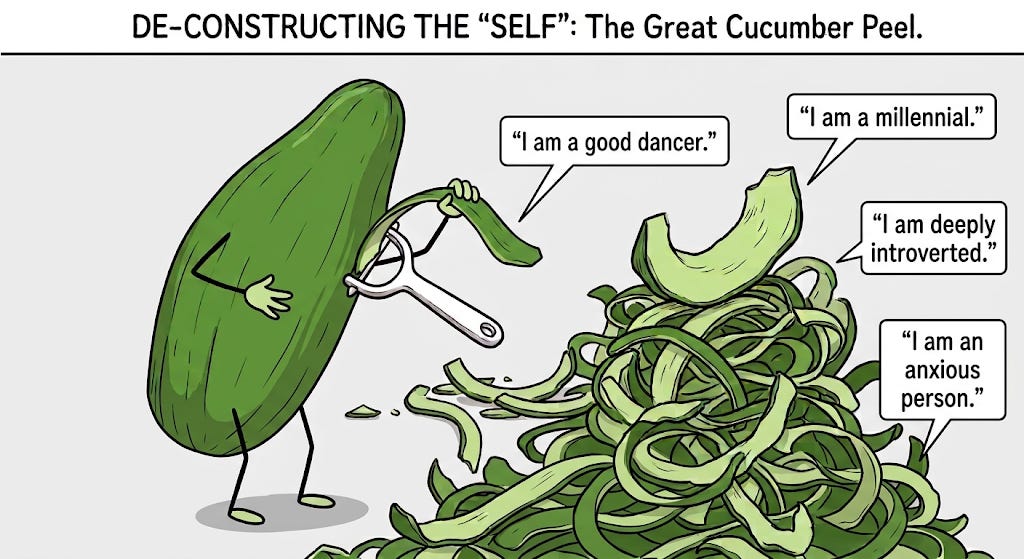
This is not a depressing exercise in nihilism. You are not destroying yourself; you are simply taking off a heavy costume you forgot you were wearing. You are dissociating from the temporary.
Phase Two: The Truth of Association
If Vedanta stopped at dissociation, it would leave you in a void. But it doesn’t. Once the false identities are cleared away, what remains is the truth. This is the second phase: association with your real nature.
When you stop identifying as a 20-something, anxious, struggling student or a wealthy, aging executive, what is left? You are the pure, witnessing consciousness that was aware of all those changing states.
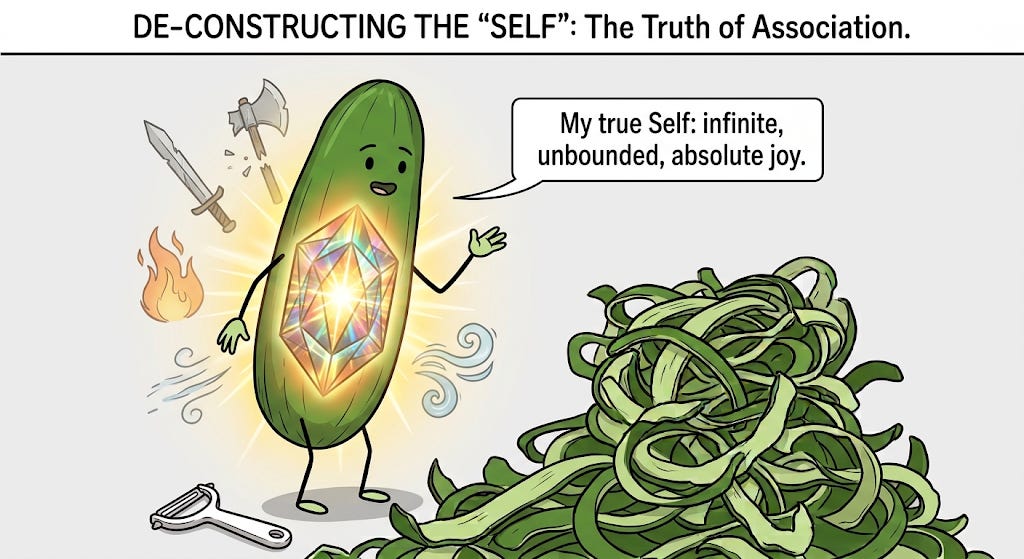
Vedanta positively reinforces you with a mathematically precise, brilliantly consistent definition of your true Self (Atman). It declares that your true identity is Sat-Chit-Ananda: Existence, Knowledge, and Bliss Absolute.
Let’s break that down:
Sat (Existence Absolute): You do not just exist; you are Existence itself. You are not bound by time, space, or causality. Bodies are born and die, but the consciousness that you are is eternal and immortal.
Chit (Knowledge/Consciousness Absolute): You are pure awareness. You are the light that illuminates your thoughts, your dreams, and the physical world around you.
Ananda (Bliss Absolute): Your real nature is intrinsically filled with joy.
This is the great paradigm shift of Advaita Vedanta. Bliss, or Ananda, is not an emotion you achieve by thinking happy thoughts. It is not a dopamine hit you get from buying a new car or getting a promotion. Ananda is your very substance.
When you mistakenly identify with your body and mind, you feel small, limited, and mortal. Because you feel limited, you feel a sense of lack, and you suffer. But when Vedanta associates you with your true nature, which is infinite, unbounded, and immortal, then that sense of lack vanishes. What remains is a profound, unshakeable joy. You become a beacon of strength because you realize there is nothing in the universe that can actually harm you. Weapons cannot cut this true Self, fire cannot burn it, water cannot wet it, and wind cannot dry it —> This is how the most revered text of practical Vedanta, the Bhagavad Gita, talks about this truth.
The Vedantin in the Modern World
The reason Advaita Vedanta is so highly revered, and the reason it is categorized as a living, breathing religious/spiritual philosophy, is because you can actually live this in the real world. This isn’t just armchair philosophy; it is psychological and spiritual armor.
We live in a world defined by shifting sands. Look at the reality of the 21st century surrounding us today:
The toxic, deeply polarized politics of the country.
Economic downturns, inflation, and the crushing cost of living.
The terrifying loss of the job market and creative industries due to the rapid rise of Artificial Intelligence.
The looming threat of another epidemic, pandemic, or global health crisis.
The constant barrage of news about another war breaking out somewhere in the middle of the earth.
If you believe you are your body, your bank account, and your career, all of these external events are perfectly valid reasons to feel utterly distressed. If your identity is “I am a copywriter,” and AI takes your job, your very sense of self is annihilated. If your identity is tied to the economy's stability, a recession feels like literal death. The person who relies on “positive thinking” will eventually break under the weight of this reality, because no amount of manifesting can stop a global recession or a war.
But this external chaos never touches a true Vedantin.
The reason is beautifully simple.
The Vedantin is first and foremost situated in their real nature. Through meticulous study and meditation, they have built an ironclad conviction that they are pure, infinite consciousness.
The secondary identity - the name, the job, the societal role is viewed merely as a role they are playing in the grand play of life (Leela).
When the stock market crashes, or AI disrupts an industry, the Vedantin does not fall apart. They understand that these problems belong to the realm of Vyavaharika (transactional reality). They deal with these issues practically, with a clear mind and a steady hand, but they never let the chaos penetrate their inner sanctum.
They know that in the realm of Paramarthika (absolute reality), they are entirely untouched. They are the screen upon which the tragic movie of the world is playing; the fire in the movie cannot burn the screen.
Even when immense problems arise in their external life, they do not fundamentally affect them. They remain entirely unruffled by the shifting sands of the world because their anchor is dropped in the infinite.
The Ultimate Optimism
This brings us back to our original point. Calling Advaita Vedanta “just positive thinking” is a severe misnomer. It is a surface-level understanding that misses the philosophy's majesty entirely.
Positive thinking is fragile. It requires you to spend mental energy convincing yourself that things are okay when your senses tell you they are not. It forces you to play tug-of-war with your own mind, desperately trying to pull your identity toward the light.
Vedanta does something much more radical: it tells you to drop the rope entirely.
It cuts through the delusions of the assumed ego. It dismantles the petty, fragile stories we tell ourselves about our limitations. It systematically deconstructs the false and, in doing so, reveals the breathtaking truth of what has always been there.
From this dual process of dissociation from the false and association with the real, you derive Ananda. This joy of your true being is not a fleeting mood; it is the fundamental hum of the universe. It is the peace that passes all understanding.
To equate this profound awakening to mere positive thinking is to mistake the vast, roaring ocean for a puddle in the street. Vedanta does not teach you how to paint a smiling face onto your ego. It teaches you how to transcend the ego entirely and claim your birthright as the infinite.
And once you realize that you are the immortal, unbroken, blissful reality behind the entire cosmos, you will find the greatest possible reason to be optimistic about life.
Love the article, it addresses a very common misconception, that Vedanta is essentially a form of positive thinking or an exercise in replacing negative beliefs with positive ones.
One additional thought that came to me was we don’t seek ourselves only from our professions or interests but even the relationships we play - mother, sister, wife, husband, friend, etc. Over time, these roles can become so deeply intertwined with our sense of self that we begin to experience them as who we fundamentally are, and if these roles are lost or altered, it leaves one feeling disoriented or with a void
I’m curious to see how Vedanta approaches this state, especially the aspect of identity.
1) Does the inquiry also involve examining these relational identities and distinguishing between the role we play and the deeper sense of “I” that exists independently of those roles?
2) And how does Vedanta reconcile this inquiry with the fact that we still have duties and responsibilities within these relationships?