

You are sitting at your laptop, staring at a blank screen, ready to build something or write something you actually care about. Then, you make the fatal mistake: you open a new tab to see what everyone else has already done.
Instantly, the oxygen leaves the room. You see twenty people who are smarter, faster, and ten years ahead of you. They’ve already built the tool, written the definitive essay, or solved the problem. Your brain runs a quick, brutal calculation: This territory is taken. The world doesn’t need my amateur version of this.
So, you close the laptop.
If you are in your twenties trying to build a career, launch a project, or just find your own voice, this is the exact psychological trap that will quietly kill your potential before you even start.
A manager of mine with 15 years of experience in the software industry recently pointed out how this happens in something as mundane as a shared Google Doc. If he opens a proposal at work and sees the margins already stuffed with other people's comments, his motivation flatlines. It’s not that he has nothing to add. It’s the heavy illusion that because so many smart people have already weighed in, his own thoughts must be completely redundant.
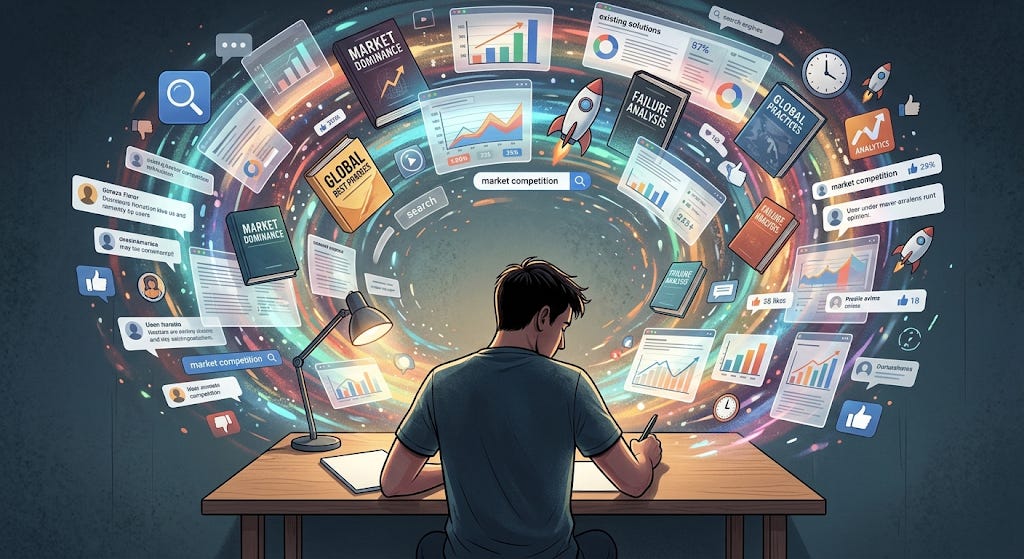
He knows this is just a mental glitch, but it still paralyzes him.
His fix? He forces himself to open the document early, before anyone else has touched it.
You have to do the exact same thing with your work. You are currently living in a heavily commented Google Doc. The internet guarantees you will always see the absolute best, most polished work in the world within three clicks. If you evaluate your own messy starting point against a crowded market of finished masterpieces, you will always convince yourself not to try.
But this assumes the world only needs one perfect, objective answer. It doesn’t. A crowded field isn’t an exhausted one. People don’t just want the absolute truth; they want your specific translation of it. They want the perspective only you can provide, shaped by your unique friction, your generation, and your experiences.
To survive this, aggressively implement a pre-comparison phase.
When you get an idea, do not research the competition. Do not read the expert consensus. Give yourself a window of total, unapologetic isolation. Write the messy draft. Build the ugly prototype. Figure out what you actually think before the world tells you what you are supposed to think.
If you expose a fragile new idea to the masters on day one, you will inevitably ask yourself, Why am I even bothering?
But if you spend just a little time wrestling with the problem in private first, the dynamic completely flips. You look at that same master and instead ask, That’s clever—what exactly are they doing that I missed?
You have to protect the beginning. Give your ideas enough silence to breathe and take shape. There will be plenty of time to let the rest of the world in later.
What is one idea you have been keeping on the sidelines because the space felt too crowded to even try?
This is one such incident when I felt as if what new I can write. And ironically this thought itself I put down as poem 😀
वे लोग जो कुछ बोल गए,
शब्द मोती-सा पिरो गए।
अब उस अद्भुत माला को
मैं रत्न कौन प्रदान करूँ?
मैं ऐसा क्या संधान करूँ?
जीवन के जटिल राग पर
स्वर अपने वे सी गए।
अब उस अप्रतिम गीत को
मैं तान कैसी लगा सकूँ?
मैं ऐसा क्या संधान करूँ?
मानव के मनोभावों पर
विवेचना ऐसी वे कर गए।
अब उस अलंकृत खंड में
अध्याय क्या संकलन करूँ?
मैं ऐसा क्या संधान करूँ?
Totally relatable!
Like writing poems. If I Google ' poems on cloud' I will get over thousand poems. And it will be so overwhelming coz some of them will appear to be much better than my first thought.
But if I follow the process you mentioned, I will definitely create something unique. 😊