

The best evidence of human agency is the simple, profound act of making a decision. If you are able to decide, you are agentic.
Decisions are the singular mechanism by which we bifurcate our lives into parallel realities. The moment a choice is made, the timeline splits. You step forward to inhabit the reality you have chosen, while the unmapped alternative - the life you could have led, the path you almost walked - slowly fades into the shadows. For some decisions, you only have to live with the consequences for a few fleeting minutes. For others, the consequences stretch out to encompass the entirety of your life, and perhaps even the lives of those who come after you.
Every morning, when I rush out the door for my commute to Manhattan, I face a micro-bifurcation. I have to decide whether to transit from Jersey City to New York via the WTC line or the 33rd St line.
I am invariably in a hurry, moving with that specific, anxious momentum unique to the morning rush. My only goal is to reach the office as fast as humanly possible. Yet, there are countless instances where I end up standing on the platform of my chosen line, only to find myself lustily watching the trains of the other line quickly whizz by.
As they pass, a familiar, irrational monologue loops in my head: Why didn’t I choose the other line?
Even though I know the stakes are incredibly low, it frustrates me. The actual consequence is minimal—a ten, perhaps a maximum of fifteen-minute difference in reaching the office. But the chafing and irritation I feel are entirely real. It is not rational to feel abrasive over a fifteen-minute delay, but the human mind rarely consults rationality when it feels it has made the “wrong” choice.
This commute is the ultimate low-stakes gamble. But it serves as a daily rehearsal for the macro-decisions of life that we all have to choose, namely:
Where do you live?
With whom do you live?
What do you dedicate your life’s work towards?
Consciously choosing a path for these questions could dictate the lived experience for the vast majority of your time on this earth. The stakes are undeniably high, for the simple reason that you will have to live within the architecture of these choices for a very long period.
Rationally speaking, the time taken to answer a question should be proportional to the stakes involved. You should take significantly more time to decide on a question that carries decades of consequences. We all intuitively feel this. We all desire a thought-through, value-maximizing framework in which, if we have clarity on our values, we can extract the maximum possible yield from our choices.
But that assumes we act rationally. And the truth is, we rarely do.
We navigate the world through a tangled web of social assumptions, raw emotions, and complex psychology. The rational decision-making framework remains a theoretical ideal, one that falls short the moment it is tested in the messy reality of human life.
Because we fear the weight of high-stakes consequences, we often succumb to analysis paralysis. Society is quick to label this delay as procrastination, but I disagree. When you are staring down a choice that will alter the trajectory of your life, pausing to understand the best-case and worst-case scenarios isn’t paralysis; rather, it is vital information-gathering.
Interestingly, I find the real reason we feel paralyzed about a high-stakes decision actually stems from a more fundamental misunderstanding of how decisions actually work.
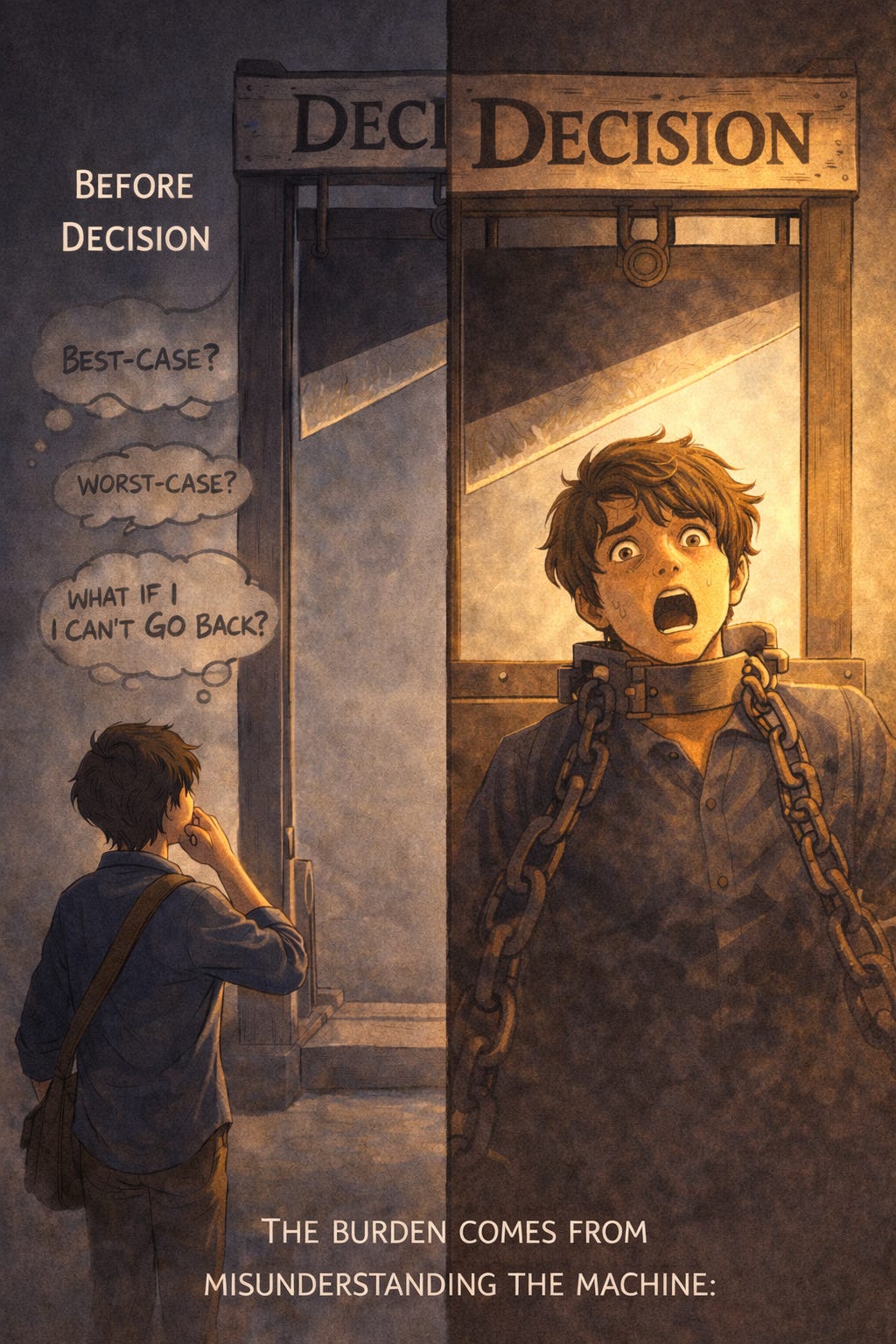
We tend to treat the decision-making process as a singular, finite “event.” We view it as a guillotine blade dropping—a moment in time where a choice is locked in. The terrifying assumption embedded in this framework is that once the decision is made, the person loses all agency. They become a mere spectator, forced to either passively enjoy or helplessly suffer the consequences of that choice as it unfurls.
If the morning train commute is the floor of decision-making stakes, history provides us with the absolute ceiling.
Consider the 1947 Partition of British India into India and Pakistan. It is hard to overstate the staggering gravity of this event. Practically overnight, millions of people had to choose between two countries. The stakes were absolute. This was not a decision about a fifteen-minute delay; this was a decision that dictated geographical roots, cultural identity, physical safety, and the geopolitical reality of entire bloodlines for generations to come.
It is easy to look at an event of that magnitude and view the crossing of the newly drawn border as the final, absolute “decision event.” But even in a scenario with the highest stakes imaginable, viewing the choice as the end of personal agency is incomplete.
The initial decision was to choose the country whose ideals most closely matched your own. But the agency did not dissolve the moment a family set foot on new soil. The true work—the heavier, more profound expression of agency—was what came next. Once established in either nation, the people had to continually work to improve their own lives and those of their chosen country.
This reveals the liberating truth about how we navigate the world: your agency does not end when a decision is made. You have agency before the choice, and crucially, you have agency after it.
If I am standing on the subway platform and see two trains whizz past on the other track, I am not helpless. I can check my phone, verify which line is moving faster, and undo my previous choice by simply walking over to the other platform.
If you decide to sign a lease in a specific neighborhood and realize two months later that it was a mistake, you are not a prisoner to that choice. You have the ongoing agency to either break the lease and find a new apartment, leveraging the new information about what didn’t work, or to bear the remaining months while actively plotting a better choice for next year.
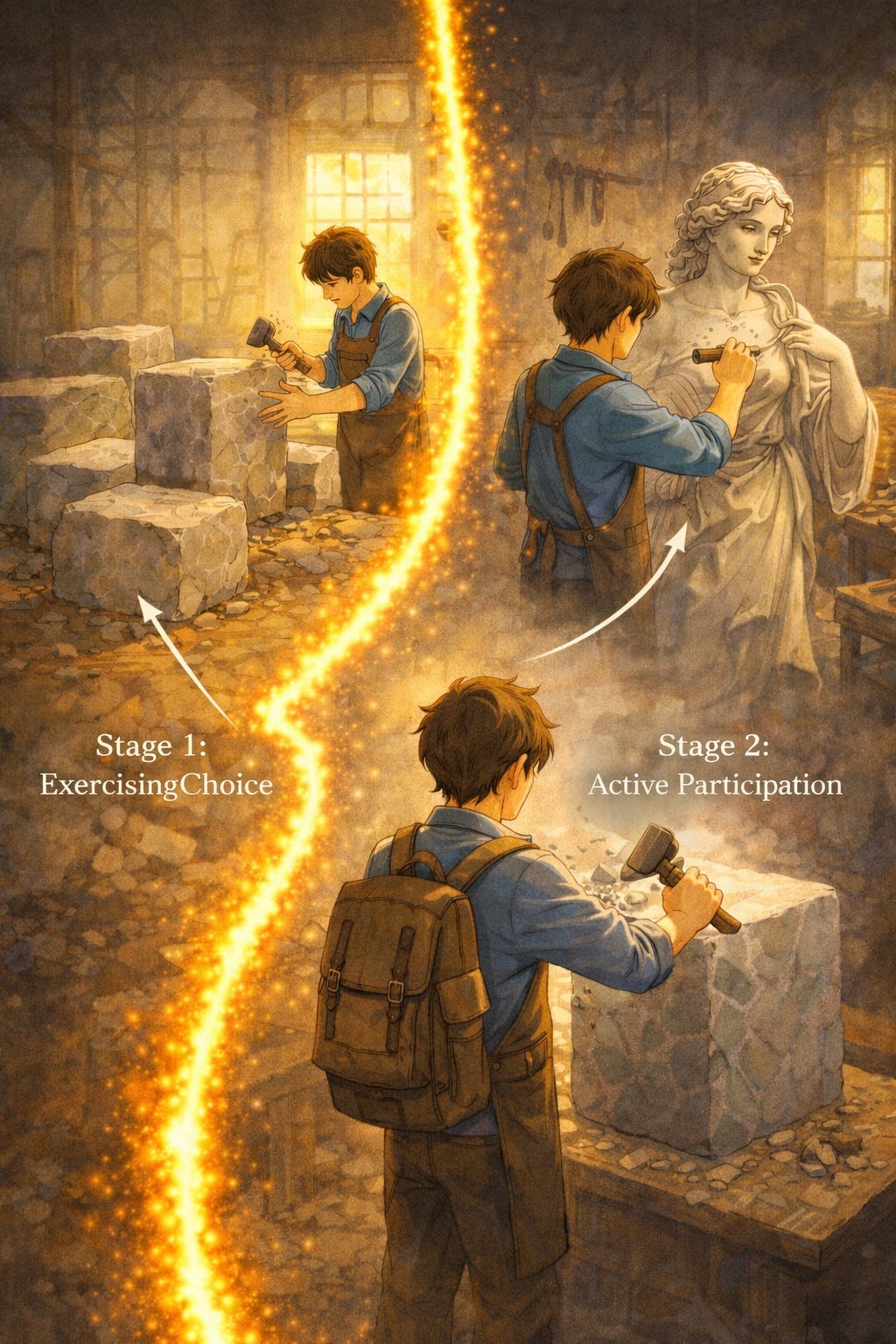
No matter how high the stakes feel, a decision never diminishes your continuous ability to iteratively improve your reality. Looked at through this lens, decision-making is not a single event, but a two-part process:
First, you exercise your choice from the given list of options.
Second, you actively participate in life afterwards to make that decision right.
This, to me, is the only complete way to approach a fork in the road. When making a decision, you must reach a state of conviction where you can comfortably choose one option over the others. But more importantly, you must feel deeply convinced from within that you possess the resilience to participate in the life that follows.
If a decision is made without conviction in your ability to deal with the consequences of both the best-case and worst-case scenarios of that option, then it means true conviction has not been reached. In that scenario, taking more time through the decision-making process to gather more information is perfectly alright.
A life of agency flows like a river. It is a continuous current of choices made, followed by actions taken to support and refine them. A life where personal agency is blocked is like a stagnating pond, suffering from the unwanted overgrowth of mushrooming thought-clouds.
When you accept that your agency doesn’t end the moment a choice is finalized, the pressure of the “perfect” decision begins to lift.
You are no longer trying to predict a flawless future.
You are simply choosing a path, trusting that whatever reality unfolds, you retain the power to shape it.
Once in my middle school years I accompanied my aunt on a short trip. After waiting for the bus for 10 to 15 minutes my aunt decided to take a cab. As the cab pulled away from the bus stop I looked back to see if any bus was arriving. My aunt reprimanded me saying once we make a choice there is no point in looking back and pondering over the other possibilities. I remember that inadvertent lesson to this day.
Very relatable.
One relevant ' choice ' dilemma that I face is to react to someone's words quick.
Like I do at times get scammed by auto drivers charging me more 😀
And while they are narrating those baseless reasons and what not, one corner of my head screams ' just walk away man' but I freeze. I end up paying more. And later feel so stupid. Same for situations when someone says something mean to me and just walks out.
Later I do come up with tonnes of things which I could have replied with , but not at that moment.
While it was happening the bigger chunk of my thinking brain is trynna defend the other guy, holding me back from being too quick to judge the person. Telling me it is okay to be scammed for some money, to gulp the mean words. Rather than jumping too quick to react and later being proven wrong. The amount of money, the damage of mean words weighs much less than the guilt of being mean to people. To the mark it itches on me.
It looks as if I am too slow to make the choice at such moment. But as you said it isn't about tapping the green or red button the quickest. It is about what comes next after that tap and how we get on with it. With guilt and looking over our shoulder the other possibility or with the belief that the more important thing isn't choosing red or green it's how we handle what comes next.