

Most people think money will settle things. You tell yourself that once your salary reaches a certain number, once you move into a better apartment, once things “stabilize,” life will feel easier. The background noise will quiet down. You’ll finally feel at rest.
But that’s not what happens.
Money changes your life. It gives you options. It removes certain constraints. But it does not, by itself, create a sense of ease. If anything, as things improve on the outside, you start noticing something more subtle on the inside.
The baseline shifts.
I’ve started to notice this in small ways. You get your first real paycheck, and for a while, it feels like relief. Then slowly, it becomes normal. You begin to look sideways—what are others making, where are they living, how fast are they moving? You upgrade one thing, then another. Nothing is wrong, but something is no longer at rest.
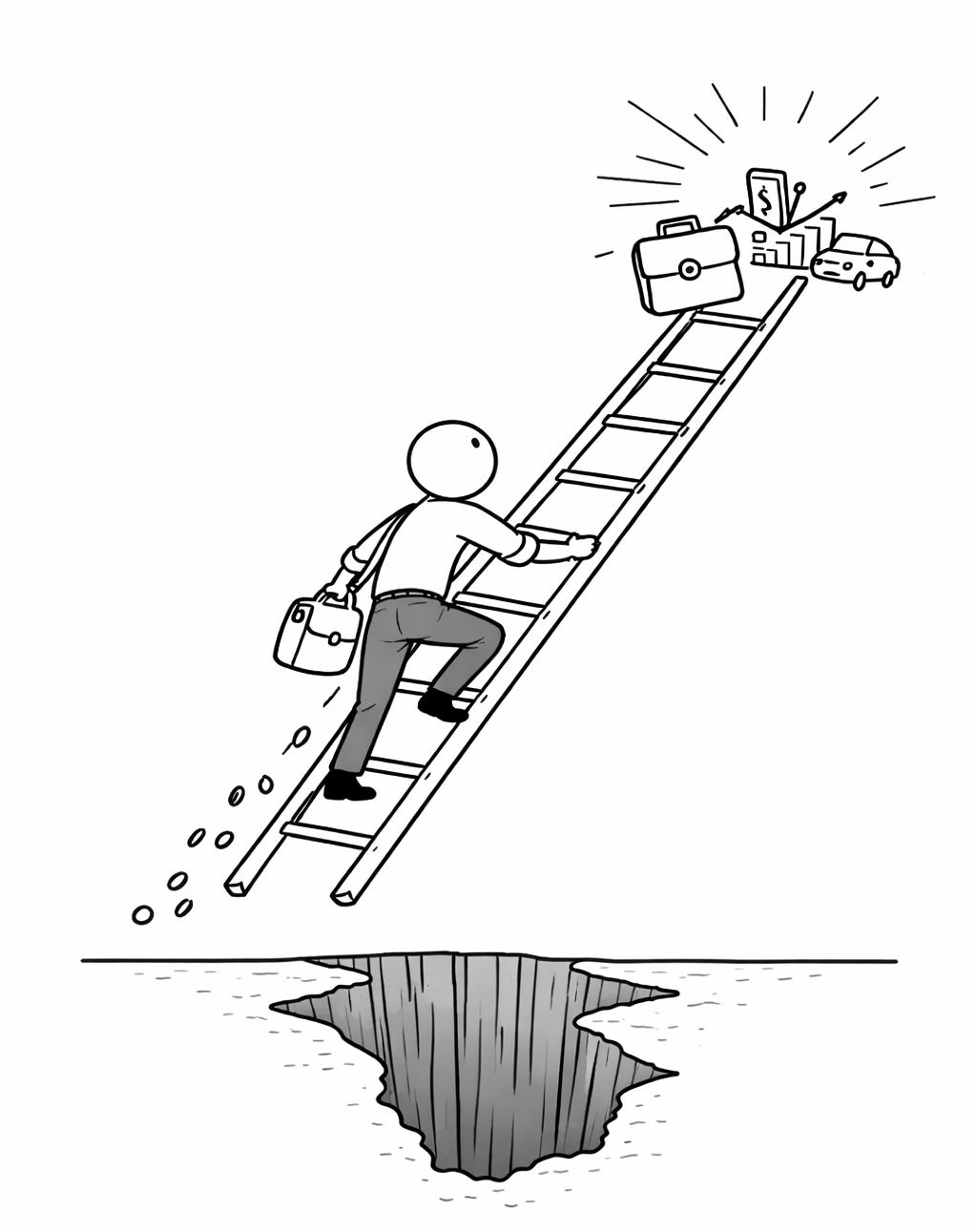
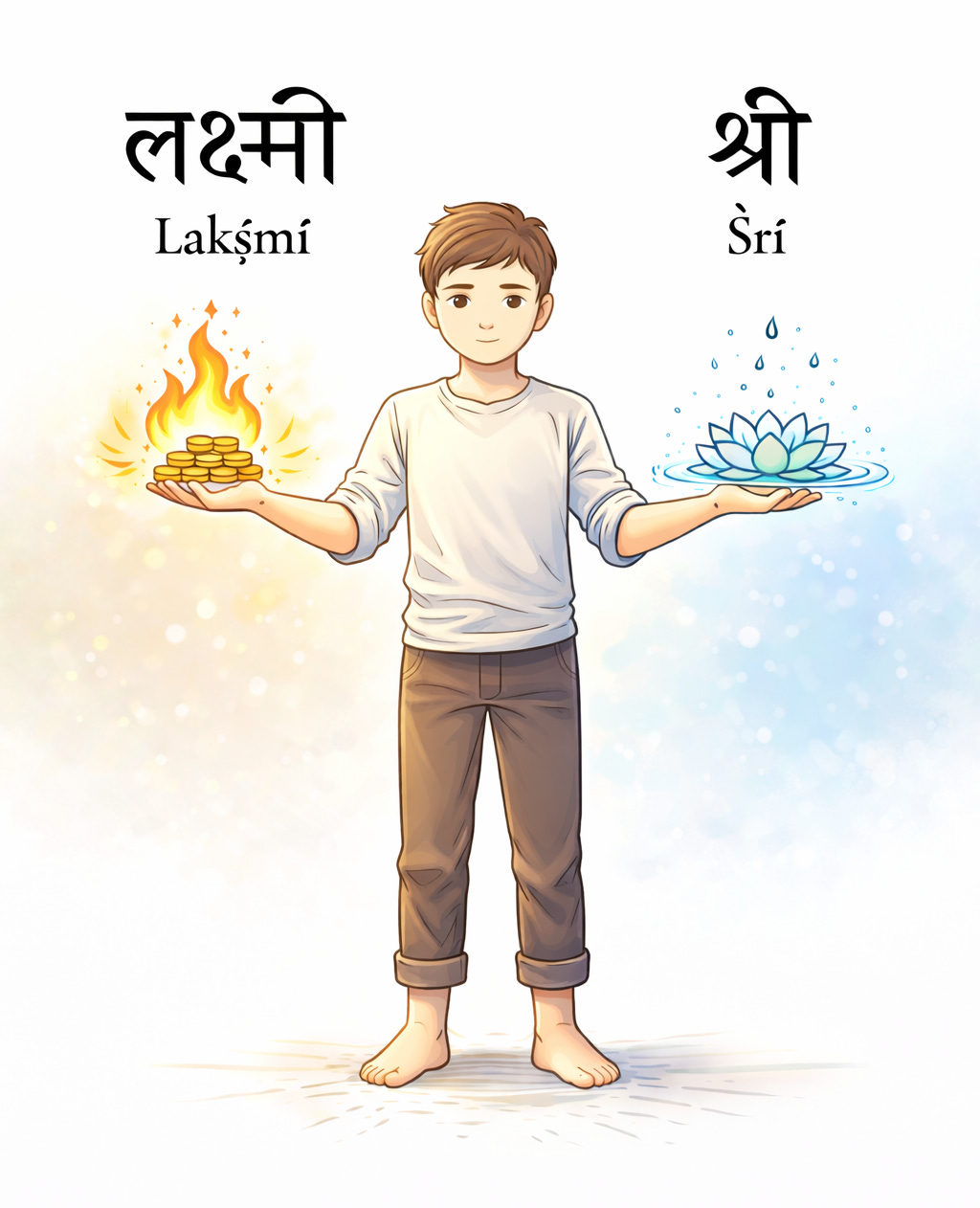
Ancient Indian thought looked at this problem with a surprising level of precision. It did not reject wealth. It did not ask you to step away from the world. It simply made a distinction that we have almost completely lost—the distinction between Lakṣmī and Śrī.
“श्रीश्च ते लक्ष्मीश्च पत्न्यौ”
Śrī and Lakṣmī are both your companions.
(Yajurveda, Vedic hymn)
Lakṣmī is what you can measure. It is your salary, your savings, your lifestyle, your ability to move through the world with fewer constraints. It is visible, trackable, and easy to compare.
Śrī is harder to see. It is how you stand inside your life. It is clarity, restraint, and a certain steadiness in how you relate to what you have. It is the ability to enjoy something without immediately wanting more of it. It is knowing when enough has already arrived.
Most of us are trained, almost by default, to build Lakṣmī. You learn how to perform, how to compete, how to get ahead. You figure out how to convert effort into results. There is a clear path, and you can feel yourself progressing along it.
But very little in that process teaches you how to build Śrī.
No one tells you what to do when things start going well. No one teaches you how to remain steady when your options expand. And so, when Lakṣmī grows without Śrī, the imbalance shows up quietly.
It does not feel like failure. It feels like restlessness.
You see it in your own habits. You reach for your phone without thinking. You scroll longer than you meant to. You finish something you were looking forward to, and instead of sitting with it, you move on to the next thing. Even on a good day, there is a faint sense of pressure, as if something is still unresolved.
You also begin to see it in others. People who are doing well by every external measure, but do not seem at ease. They are always moving, always optimizing, always leaning forward. They have more than enough, but they do not know where to stop.
Two people can be in the same position—earning similar salaries, living similar lives—and yet feel very different inside. One feels stretched, pulled by everything he has built. The other moves through the same life with a sense of center. The difference is not in what they have. It is in how they hold it.
This is where the distinction becomes sharp. Without Śrī, Lakṣmī does not remain neutral. It begins to distort. What could have brought ease starts creating pressure. What should have expanded your life begins to demand more from it.
There is a common belief that knowledge and wealth do not go together—that if you pursue one, you lose the other. It sounds convincing, but it misses the point. The older view did not accept this separation. It asked for both. Wealth without clarity becomes crude. Clarity without engagement becomes disconnected. A meaningful life requires their integration. I would dare say that this misconception was the root cause of India's downfall over the past thousand years. It completely disregarded Lakshmi while making a purist claim of knowledge.
Modern life, however, is heavily tilted in the opposite direction. Everything around you is designed to help you build Lakṣmī. You are encouraged to grow, to scale, to accumulate. But almost nothing is designed to help you build Śrī. The inner side of life is left to chance.
And so the gap grows.
Externally, things improve. Internally, something feels slightly off. You start needing more stimulation to feel engaged. Rest becomes harder. You enjoy less of what you once worked for. It is not dramatic, but it is persistent.
The older thinkers described life as having two sides:
The outer world of action and achievement, and
The inner world of awareness and understanding.
A complete life requires both to develop together. If one grows much faster than the other, the imbalance eventually shows up in how life is experienced.
The solution is neither to step away from ambition nor to chase it blindly. It is to deliberately grow both sides. You need clarity to see what you are doing, energy to act, and resources to build. When these come together, life feels coherent. When they do not, even success carries weight.
This reframes what it means to do well. It is not just about moving forward. It is about becoming capable of living well with what you are building. That capacity is not automatic. It has to be developed alongside everything else.
So the question changes.
It is no longer just: How do I grow faster?
It becomes: Am I becoming someone who can hold this growth without being unsettled by it?
Because if you are not, then at some point, the very things you worked for will begin to feel heavier than they should.
The old insight puts it simply: Śrī and Lakṣmī belong together. Not in conflict, but in balance. Not as ideals, but as requirements.
And maybe the real work of this phase of life is just this—to make sure that as your life expands on the outside, something within you is also becoming steady enough to hold it.