

There was a time when the idea of death seriously scared me out of my wits. I had done well for myself in terms of education and career, but after attaining all that my early teenage self could have wanted, I realized I had nothing to look forward to unless I generated a fresh set of desires and ambitions for myself.
This was a weird state to be in, to be honest. I could clearly see that no one around me had suddenly felt a loss of things to look forward to, especially since I was 23, and at that time, when I looked around, I saw that my friends had way too many things they wanted to try out. So this question of there being nothing to get excited about wasn’t popular at the outset.
The bigger question that I couldn’t move past was this: If, in the end, we are going to die, what is the point of doing anything worthwhile anyway? And I am not posing this question rhetorically. Rather, my whole being got stuck on this question with such immense gravity that I genuinely felt that if it was not properly answered, it would lead me to existential nihilism.
All that I knew at that point in time pushed me towards the above question, and I could also neatly observe that there was a grain of authenticity in probing this way. For isn’t this the truest fact: that we will die at some point, and that everything around us is temporary?
This sort of enquiry is hard to curtail unless you really find a proper solution to it. And this forced me to begin my own search, or what is called spiritual seeking in more pop-lingo.
Now, nine years later, after getting a chance to thoroughly immerse myself in the tradition of Advaita Vedanta, when I look back in hindsight and see the same question, I can see all the fallacies I was making. And I can see that if I had not met a teacher and a well-revered tradition, I would have gone crazy one way or another.
The reason I say this is because I can now clearly see that the very statement, “I will die,” which paralyzed me with extreme fear, is itself wrong or incomplete.
“I can’t die” is the right statement here.
Or, another way to say this more emphatically is:
“It is impossible for ‘I’ to die because ‘I’ is the subject in which the whole world, mind, and bodies are created and perish.”
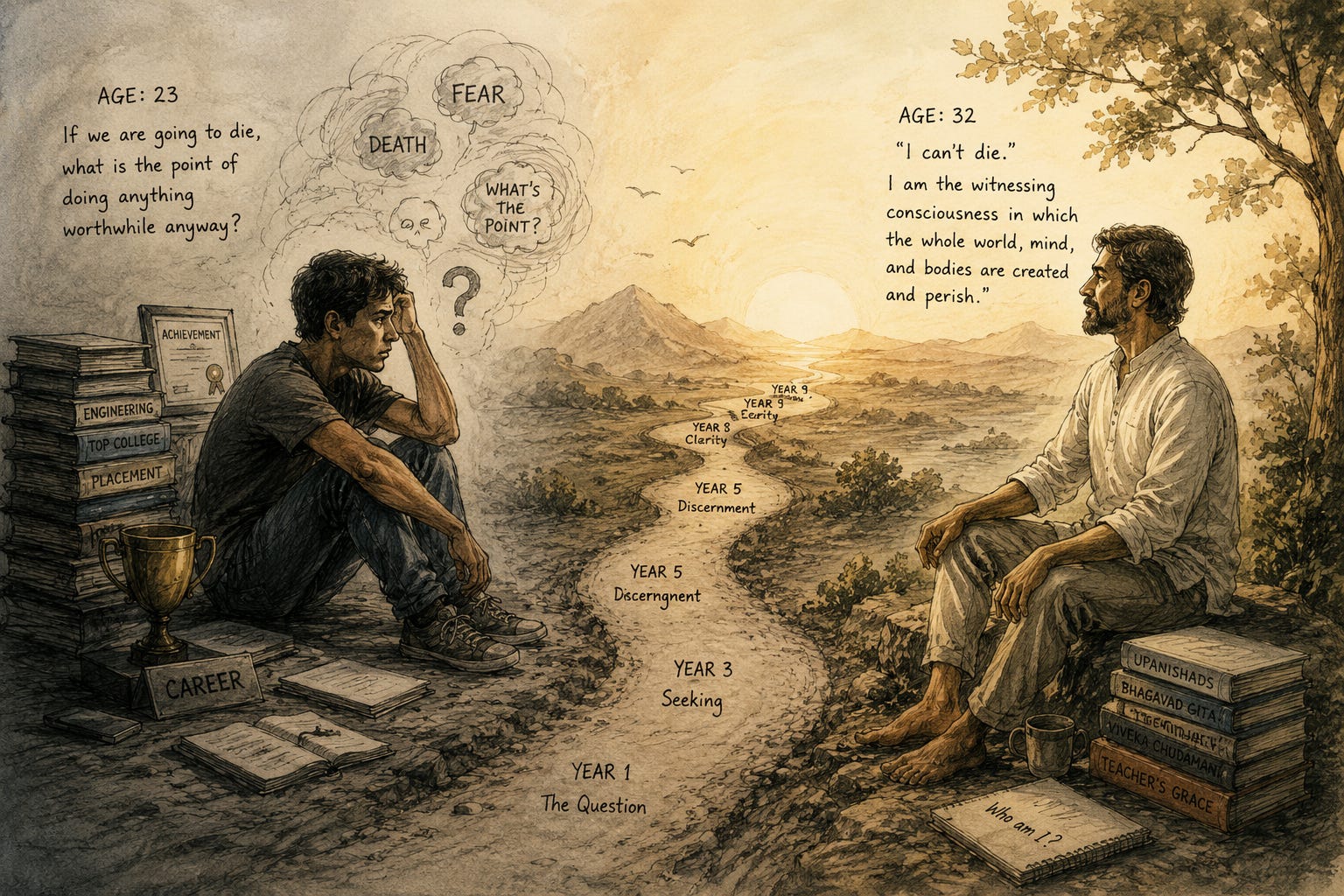
I was stuck on my initial question for a good year, and it took me eight years to reach the above conclusion. And in the process, I got my existential peace back.
What a heck of a journey!
This I am convinced of : There is no death. There is only life, flowing through changing forms. Holding on to any one form is death, realizing that life which is the foundation of all forms is amrutattva i.e. death-less-ness.