

We live with a very simple assumption.
Happiness comes from the world.
From getting what we want. From things going our way. From the right combination of money, relationships, recognition, fitness, and experiences. This belief is so deeply wired into us that it rarely gets questioned.
It also seems to be confirmed by experience.
You want something. You get it. You feel good.
Case closed.
But there is a section in Panchadasi (Ch-11) that asks us to look again, more carefully, and test this assumption as a hypothesis rather than accept it as truth. The hypothesis it proposes is counterintuitive, almost uncomfortable:
Happiness does not come from objects.
Objects only end the disturbance created by desire.
When that disturbance ends, what is already present shines through as happiness.
This feels wrong at first glance. So instead of asking you to believe it, let’s walk through it step by step.
Step 1: Observe the Pattern You Already Live
Take something recent.
You were waiting for a message. Or chasing a deadline. Or trying to hit a number at the gym. Or waiting to hear back after an interview.
Notice what happens in that state.
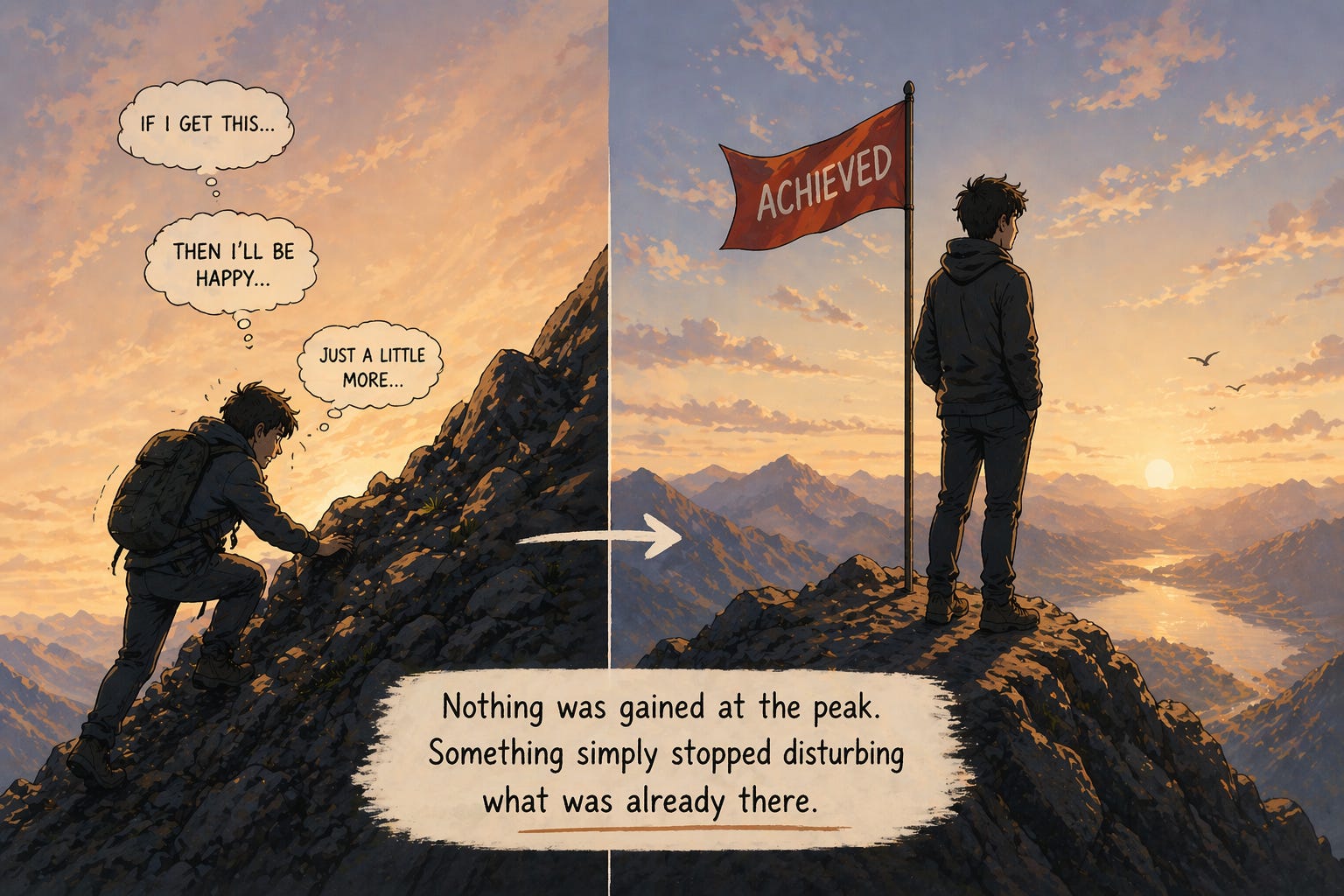
The mind is not quiet. It leans forward. It loops. It keeps checking, thinking, anticipating. There is a subtle contraction in your attention, a sense that something is incomplete right now.
Then the thing happens.
The message comes. The number is hit. The result arrives.
And immediately, there is relief.
Not dramatic joy. Just a quiet sense of “okay.”
But it doesn’t last. Soon enough, something else replaces it.
Another loop begins.
Another “if only this happens…”
If you look honestly, this cycle repeats everywhere in your life. The objects change; the structure doesn’t.
Step 2: Identify What Actually Changed
Now we slow the process down.
Before fulfillment, there is desire. After fulfillment, the desire is gone.
What else changed?
The text captures this precisely:
कामः संकल्पजः प्रोक्तः संकल्पो विषयात्मकः ।
तस्मिन् सति कुतः शान्तिरतः शान्तौ सुखं भवेत् ॥
kāmaḥ saṅkalpajaḥ proktaḥ saṅkalpo viṣayātmakaḥ
tasmin sati kuto śāntir ataḥ śāntau sukhaṃ bhavet
Desire is born of mental projection, and that projection is of objects. As long as it persists, how can there be peace? Therefore, only when it subsides does happiness arise.
This is almost mechanical.
Desire is not just a thought. It is a disturbance. As long as that disturbance is active, the mind cannot rest.
When the desire ends, the disturbance ends.
And in that moment, you feel good.
So, we ask again: what caused the happiness? The object, or the ending of the disturbance?
Step 3: Test the Object as the Cause
Let’s apply a simple test.
If objects truly produce happiness, they should do so reliably.
The same object should give you the same happiness every time.
But that’s not how your life works.
The same achievement that once thrilled you now feels normal. The same person who once excited you now sometimes irritates you. The same food that once satisfied you now feels repetitive.
The text puts it cleanly:
यदि स्याद्विषयात्सौख्यं सर्वदा स्यात्तदा नृणाम् ।
न चैवं दृश्यते लोके तस्मान्न विषयात्सुखम् ॥
yadi syād viṣayāt saukhyaṃ sarvadā syāt tadā nṛṇām
na caivam dṛśyate loke tasmān na viṣayāt sukham
If happiness came from objects, it should be present always. But this is not observed; therefore, happiness does not come from objects.
Rather than calling this a philosophy, isn’t it more like just an observation?
Objects are inconsistent. Therefore, they cannot be a stable source of happiness.
Step 4: Locate the Real Source
If the object is not the cause, then what is?
The text answers:
न विषयात्सुखं किञ्चित् तत्र दुःखस्य दर्शनात् ।
शान्तौ तु स्वात्मनि प्राप्तौ सुखमित्यवगम्यते ॥
na viṣayāt sukhaṃ kiñcit tatra duḥkhasya darśanāt
śāntau tu svātmani prāptau sukham ity avagamyate
No happiness comes from objects. Rather, when the mind becomes quiet and rests in the Self, happiness is understood to be there.
This is the turning point.
Happiness is not something that comes into you from outside. It becomes visible when the mind stops agitating.
The object did not deposit happiness into you.
It removed the disturbance.
Step 5: Understand the Mechanism Clearly
The next verse sharpens this further:
मनोवृत्तौ निवृत्तायां शान्ते स्वात्मनि तिष्ठति ।
आनन्दः स्फुरति स्वात्मा नित्यसिद्धो निरन्तरः ॥
mano vṛttau nivṛttāyāṃ śānte svātmani tiṣṭhati
ānandaḥ sphurati svātmā nityasiddho nirantaraḥ
When the mental movement subsides, the mind rests in the Self. Then bliss shines forth—ever-present, continuous.
The keyword here is sphurati—it shines forth.
This is not production. This is a revelation.
Think of it like this.
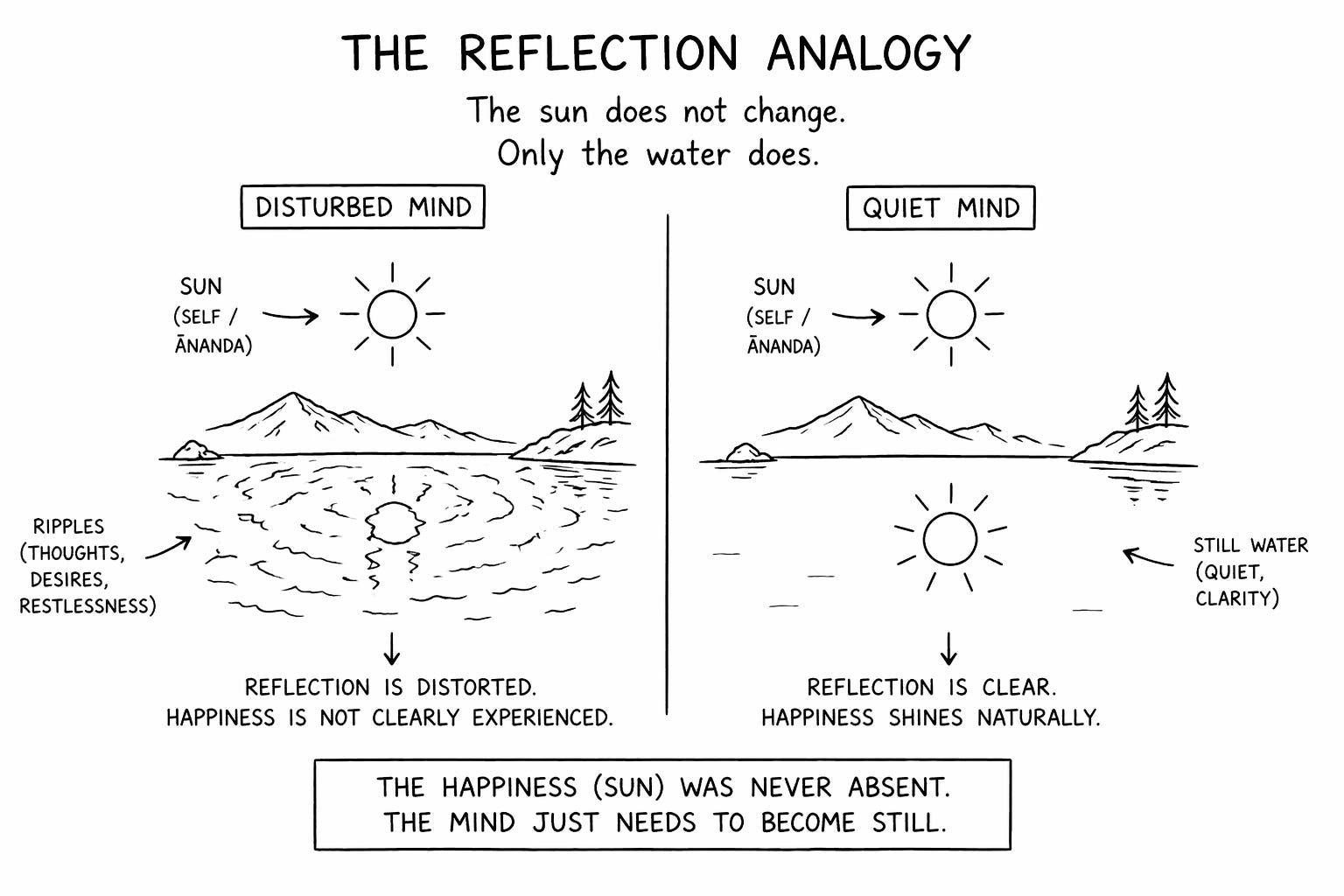
When water is disturbed, the reflection is broken. When the water becomes still, the reflection appears clearly. The stillness did not create the reflection. It allowed it.
In the same way, the quiet mind does not create happiness. It reveals it.
Step 6: Verify Through Deep Sleep
At this point, a doubt remains.
Maybe objects are not everything, but surely, they still matter?
The text now introduces something you cannot argue with: your own deep sleep. In deep sleep, there are no objects. No achievements. No thoughts. No striving. And yet, when you wake up, you say, “I slept well.”
The verse states:
सुषुप्तौ निर्विषयेऽपि सुखमस्मीति भावनात् ।
अनुभूतं हि तत्सुखं स्मर्यते जाग्रता पुनः ॥
suṣuptau nirviṣaye’pi sukham asmīti bhāvanāt
anubhūtaṃ hi tat sukhaṃ smaryate jāgratā punaḥ
Even without objects in deep sleep, one later recalls, “I was happy.” That happiness must have been experienced, since it is remembered.
This leads to a stronger statement:
न तत्र विषयः नापि वृत्तिर्नापि च चेतनम् ।
तथापि सुखमित्युक्तमतो स्वात्मा सुखं स्वयम् ॥
na tatra viṣayo nāpi vṛttir nāpi ca cetanam
tathāpi sukham ity uktam ataḥ svātmā sukhaṃ svayam
There is no object, no mental activity, no active knowing—yet happiness is affirmed. Therefore, the Self itself is happiness.
This is decisive.
Happiness exists without objects. Therefore, it cannot depend on them.
Step 7: Why Happiness Seems to Come and Go
If happiness is always present, why does it feel unstable?
The text answers through a simple analogy:
यथा दर्पणसंस्थेऽपि रूपं भाति न दर्पणात् ।
तथा बुद्ध्यावभासेन भाति आनन्द आत्मनि ॥
yathā darpaṇasaṃsthe’pi rūpaṃ bhāti na darpaṇāt
tathā buddhyāvabhāsena bhāti ānanda ātmani
Just as a mirror reflects a form but does not produce it, the mind reflects happiness but does not create it.
When the mind is restless, the reflection is unclear. When the mind is quiet, the reflection is clear.
The source does not change. The condition of the mind does.
So, what you call “more happiness” or “less happiness” is simply the mind being more or less disturbed.
Step 8: The Reorientation of Life
If this remains an idea, nothing changes.
You will agree with it, appreciate it, and then go back to living exactly as before, chasing the next object, expecting it to finally settle you.
But if you begin to observe this directly in your own life, something shifts.
You still pursue things. You still work, build, train, write, love, and engage fully with life. That doesn’t go away.
What begins to dissolve is the quiet assumption that something outside will complete you.
You start noticing the mind more than the object it is chasing. You see how restlessness forms, how it sustains itself, and how it drops.
And when it drops, even briefly, you begin to recognize something that was not created in that moment, only uncovered.
This recognition changes the texture of action.
Effort remains, but strain reduces. You still care about outcomes, but they no longer carry the weight of your inner state. You act fully, but without leaning on results to stabilize you.
Over time, the central question of your life shifts.
It is no longer, “What do I need next to feel okay?”
It becomes, “What disturbance am I adding right now that prevents me from seeing what is already here?”
The mature life is not a life without desire or effort. It is a life where desire is seen clearly, effort is made fully, and neither is mistaken for the source of happiness. What remains is not something new. It is simply a mind that interferes a little less. And in that, what was always present need not be sought again.
Well written and well articulated as you usually do. It seems like a strong argument on the face of it. But I am going to differ :)
The premise - "Objects only end the disturbance created by desire. When that disturbance ends, what is already present shines through as happiness." seems a good enough solution.
Desire arises, I fulfill desire, I feel happy and content. Hunger arises, I eat food, I feel sated.
Do I expect not be hungry again ? Not at all. What do i do if I feel hungry again ? I repeat.
Do we blame food for the hunger ? No we do not. We take it as a necessity. So why can we not treat object the same way ?
In this argument, the author points to objects as the the obstruction to happiness (Step 2 - "Desire is born of mental projection, and that projection is of objects."). imo blaming objects is a problem with this argument.
And you can see the issue come up again in the solution in Step 5 "When the mental movement subsides, the mind rests in the Self". It does so in deep sleep as stated in Step 6. So why is deep sleep not the solution ? No objects, total happiness.
In second shloka in Step 6, imo the author has the implication reversed "There is no object, no mental activity,". Maybe it should be "no mental activity implies no mental object". Or maybe one has to understand what the author really means by "visaya".
Or maybe an expectation of eternal happiness is a problem in itself ? áthā kó veda :)