

After writing for so long by myself, slowly I have managed to find a critical mass of people who live around me and who are also interested in the written word. We met for the first time yesterday for a journaling workshop. Most people came not knowing what to expect, but given that we had a person guiding us through the process, many people had breakthroughs and, overall, a positive experience. The original plan was to meet for an hour, but we were so deeply gripped by the process that two hours flew by without us noticing, and eventually we finished the session at 7 PM.
I have personally been writing morning pages for some time, in consistent bursts of months, but still there is something memorable about meeting in person with others versus doing things alone. Couple this with somewhat professional-grade guidance, and we had a memorable session.
Here, in this post, I would like to break down the whole journaling process that we followed, and maybe it helps someone else get started with it too. This came from a person who has studied the science of journaling professionally at NYU, so I believe there are some scientific guidelines embedded in this, and thus one can derive benefit from following this in the long run.
A few guidelines:
1. The process is divided into three short bursts of writing, each of six minutes, and the most important rule is to not stop writing during those six minutes at all costs. Even though you might feel you have run out of thoughts to write, you still have to keep the pen on paper and continue writing. This is important.
2. If you are doing this in a group, a quick introduction is good. The way our instructor facilitated this was by having cue cards distributed to everyone, each with an innocuous question on it. Everyone, in turn, quickly answered one, and thus opened up the group for impromptu conversations with each other.
3. Again, another group thing that can be done is to share how your writing went, with some pointed questions for a few people, at the end of each six-minute session. This way, it becomes a deeply conversational vibe and no one gets cocooned within themselves at any time. People who show up for writing workshops can be deeply introverted but brilliant thinkers in their own right, so a little bit of prompting generally helps everyone.
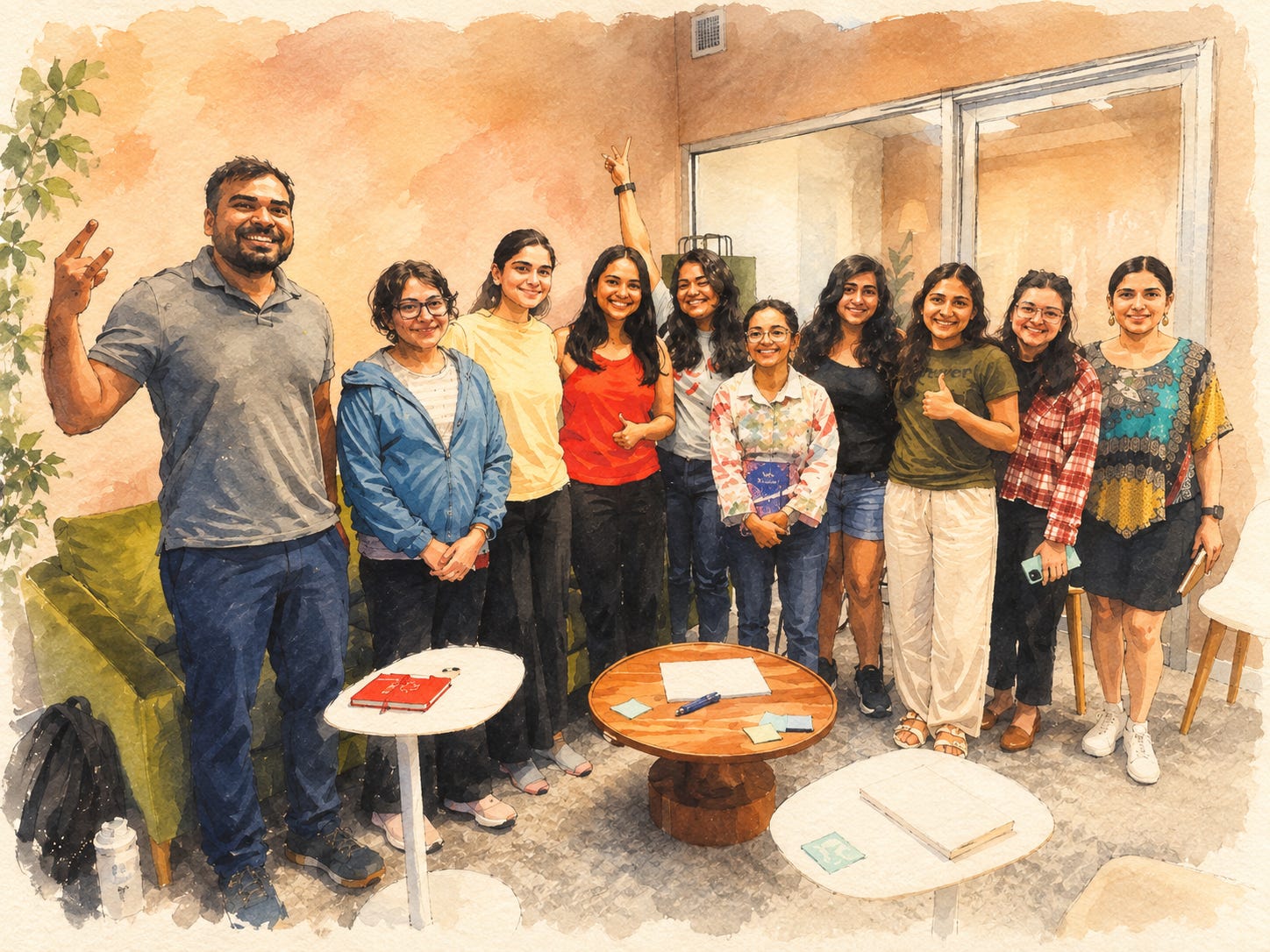
Alright, these are the basics of running a journaling workshop, and of course how it goes depends a lot on how it is managed and how the participants enjoy the act of participating. But nurturing a jovial attitude, while also being lightly instructive and firm, helps in keeping everyone consistent.
Now moving on to the next part: the set of three questions, which I find to be the heart of this workshop, are the following:
Q1. What happened today?
Q2. What mattered to me and why?
Q3. No question. Just read through your answer to Q2 and mark those sections that truly make sense to you. You can scribble more insights on the sidelines and in the margins if you want to go deeper into it.
The way these questions acted upon me was as if the first question acted like a magnifying glass, the next one as a microscope, and the third one as an even more powerful microscope. So much so that all of us agreed that these sessions moved us from our mundane state of mind, which was mostly what we wrote when answering the first question, to a subtler and almost exclusively reflective space when we answered the third question.
And when all of us reached the third part, we were feeling deeply positive. We had managed to get rid of all the noise that we are generally almost always tuned into, and finally arrived at deeper realizations and a groundedness within ourselves.
Here I have shared what I wrote for each section, so that this becomes even more evident to the reader: how powerful this session can be. Personally, this is how it evolved for me.
1. What happened today?
A lot happened because I could only come home by 12:30 AM, and one thing or the other kept attracting my attention, so I couldn’t sleep by the ideal time I should have.
What this did was make me realize that I would have to miss my morning yoga and strength-training session. And I felt a dread in my spine because saying that I wanted to postpone my sessions to either of these teachers meant talking about and explaining why, again, I needed to worry about this.
Anyway, I woke up by 10, missed my strength-training session, still did yoga thanks to the flexibility that my instructor provided me, and then moved on to my shower and meditation.
2. What mattered to me and why?
The fact that I have become a people person, and that I look forward to explaining my POV to others slowly and patiently, is one of my most important learnings in recent times.
Be it leaving VNs for Kakoli and Prithwish, writing messages for Sagar, calling Naresh Jain, accepting the position to write for my undergrad’s page on LinkedIn, or seeing my summary from the GAM get forwarded and attract the right crowd all of this sort of opened the day for me in a great way.
And it is these conversations that really make me enjoy my time spent in the company of others.
In general, just knowing the fact that our “I” is shared is my greatest learning from Advaita.
3. Going deeper
When I went through the previous section and marked the parts that made the most sense to me, three things stood out:
People
Conversations
“I” is shared
They are all different facets of the same fact.
Practical Vedanta, in a way, with the intentionality of infinite ambition imbued into it alongside.
This is sort of the crux of where I am at. And I like the fact that I am here, or have managed to knock on this door.
For what is life if it is not interspersed in accordance with the principle of the “Real I”? For that is the truth of life.
Hope this helps someone to start a writing club, get into journaling personally or in a group setting, and get intimate with the power of intentional writing and how powerful it is when done consistently.
Thank you.