

We are culturally conditioned to believe that we are the sole architects of our survival. The world relentlessly drills a singular, unforgiving mantra into our heads: there is no free lunch.
We are taught that every ounce of security, every scrap of happiness, and every fleeting moment of peace must be earned through grinding effort. If you drop the ball, the sky falls.
But there is a profound, almost rebellious counter-narrative to this modern anxiety, and it is found in the essence of true devotion. One of the most liberating reasons to practice Bhakti is the internal, undeniable realization that you are fundamentally borrowing your existence from an entity that is vastly bigger, infinitely better, and eternally more blissful than you are.
When you truly internalize this, the paradigm of your life shifts. It means recognizing that there is a divine presence whose actual, cosmic job is to keep us alive, to keep us fed, to keep us happy, and to keep us intelligent.
We walk around carrying the crushing weight of the world on our shoulders be it job stress, financial panic, relationship friction, and the endless, mundane anxieties of simply being human. We hoard this stress in our minds as if worrying is the fuel that keeps the universe running.
But if you have genuine Bhakti, you realize that all of this mental and emotional baggage can be directly transferred to the source of your existence.
You are not the original source of your own life. You are a localized expression of it. The divinity that sparked the cosmos is the exact same divinity that has lent you your existence, lent you your knowledge, and lent you your capacity for joy. In the traditions of Vedanta, this ultimate reality is described as Sat-Chit-Ananda: absolute Existence, absolute Consciousness, and absolute Bliss.
Because we are inextricably plugged into this source, we have the ultimate safety net. Whenever you find yourself thoroughly lost, overwhelmed, or super confused by the labyrinth of life, you can radically depend upon that entity.
This is arguably the most practical, grounded use of Bhakti and Vedanta. It strips away the esoteric mystery and leaves you with something highly functional: you are no longer alone.
Through devotion, the divine becomes a multi-tool for the soul. You always have a friend to walk with you through the dark. You always have a teacher to provide sudden clarity when the path splits. And, perhaps most comfortingly, you always have a cosmic trashcan into which you can throw all your burdens, doubts, and the mental garbage that relentlessly accumulates in your mind. You are allowed to say, "I cannot carry this anymore; you take it."
Of course, this level of absolute surrender is not a switch you can simply flick on. It is the most precious thing a person can possess, but it must be fiercely cultivated. The human ego is stubborn. We want to be in control, and we will fight to maintain the illusion that we are managing our own universe. Usually, it is only after immense effort, after trying to fix everything ourselves, and after becoming utterly exhausted, that the ego finally cracks. It is in that profound exhaustion that a person generates a genuine, internal agreement. You finally concede that there is a real, spiritual reality functioning beneath the surface of things. You realize that this divinity is not just an external concept, but our very true nature.
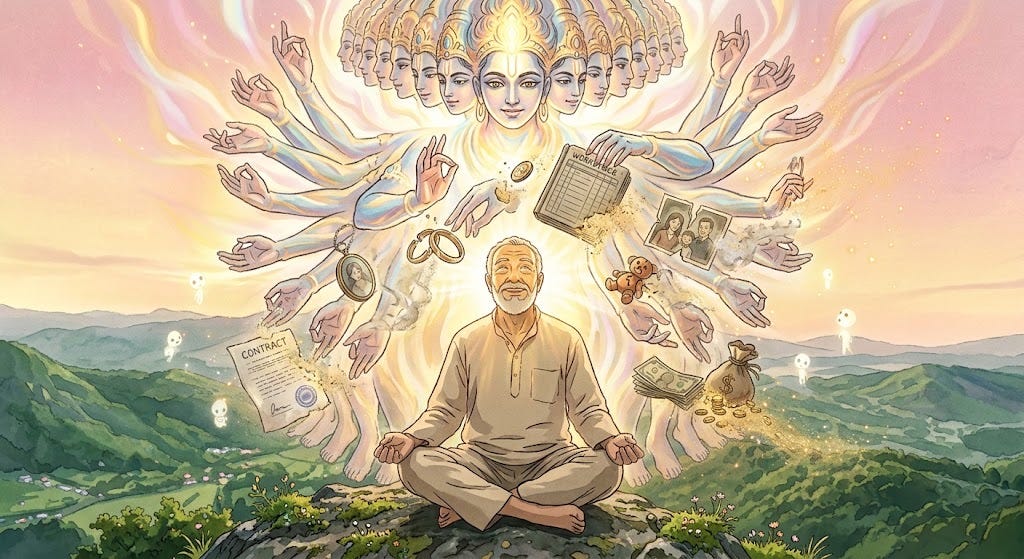
Reaching this point of surrender is a quiet revolution. You stop treating the divine as a vending machine for your desires and start treating it as the foundation of your being.
While it is a lifeline in times of crisis, its utility does not end when the storm passes. Even when the waters are calm, this connection remains the ultimate source of pure bliss. It is an inexhaustible well of joy that does not depend on external circumstances, promotions, or perfect relationships. It is happiness for the sake of happiness.
Cultivating this deep, abiding trust -allowing yourself to be held by the very force that breathed you into existence - is the ultimate antidote to the modern human condition, and the single greatest reason to walk the path of devotion.
Beautiful and inspiring, and deeply comforting ❤️
In fact a recent article in nytimes talks abt how a common thread in successful people is there willingness to accept help from other people and resources.
https://www.nytimes.com/2026/08/28/opinion/successful-people-help.html?smid=nytcore-android-share