

Why Ideals Matter More Than We Admit
We are all in search of a human ideal, whether we acknowledge it or not.
Why, you may ask?
For we constantly need a bright torchlight that illuminates our future. In the absence of that, the questions and doubts around meaninglessness and guilt for wasting one’s precious life would otherwise gnaw us from the inside out.
I wonder if someone doesn’t feel this way, for if that is really the case, then I would argue that — that person has not even started to contemplate their own morality, the limited time and bandwidth we get to experience this life, the preciousness of the time that is otherwise dripping away moment by moment towards an impending doom for this bodily existence.
The starting point of inquiry, whether in art, science, or religion, is, in one way or another, this fear of the limitedness of our existence and the impending doom.
What an ideal does is, it blasts an effulgent light of clarity through this fear. If you are someone whose personal disposition is that of an artist, then this fear of death should drive you to become a Leonardo Da Vinci. If you have a personal disposition of a musician, then this fear of death should force a Beethoven(or an A.R.Rahman - you get to choose!) out of you. If you have a personal taste of scientific rigor, then this fear of death should stimulate an Einstein(or Nikola Tesla!) out of you.
The point I am trying to home in on is the same. A human ideal is a strong antidote to fear.
What is going on behind the scenes? Why does a human ideal uproot us out of our deep, dark, negative selves?
I believe it is so because when we contrast the lives of these people against the default ticking of time, the slow approach of the impending doom that our life is approaching, that contrast is so overpowering that the ideal analogy generates a tremendous uplift, without which life would seem impossible to live. And hence, ideals are deeply attractive to the human mind.
You might accuse me of painting a rather gloomy picture to explain to you the need for ideals in our lives. But let us also take a positive outlook on it.
A human ideal performs a precise function. It plants a possibility in the mind. It expands what feels attainable. Life, which under daily routine can begin to feel like mere repetition, suddenly acquires an optimistic charge. Without such an ideal, the mind slowly contracts.
What happens if you don’t consciously choose your ideal? Based on what I’ve outlined above, it might seem that without an ideal, we’d become suicidal, with the fear of death eating away at us. But interestingly, while my earlier point might suggest that, in reality, when our lives aren’t grounded in an ideal, they often get taken over by its distant and less noble cousin - peer pressure.
Peer pressure is essentially how our aspirational energy gets trapped, without our choice of direction. We see people around us buying homes, getting married, getting promoted, and an unexamined urgency builds up to follow the same trajectory. Peer pressure is a distant cousin of following a personal ideal. It borrows the energy of aspiration but strips it of direction. It pushes without meaning.
Following an ideal and submitting to peer pressure may look similar on the surface, but they are opposites in effect.
In following an ideal, one taps into individual capability and personal ambition.
Under peer pressure, one is forced into actions that have not been consciously chosen.
The result is a vague but persistent burden.
If someone struggles with peer pressure, choosing an ideal can free up enormous cognitive bandwidth. The same aspirational energy that was previously scattered in comparison and anxiety becomes focused. Without a consciously chosen ideal, that energy often leaks into imitation.
With one, it gains direction. Effort feels cleaner. Life feels less noisy. Without such direction, one does not merely feel stressed but also vaguely misplaced.
Why Childhood Ideals Endure
Among all ideals we accept, the strongest ones are often those encountered in childhood.
Childhood impressions last because nothing questioned them. What entered the mind early entered without resistance.
This is why childhood memories endure. The world itself has not changed dramatically, but our way of grasping has gone through revolutionary change in the meantime.
As adults, everything that reaches us passes through layers of judgment built slowly through experience. This filtering is necessary. It allows us to function responsibly in society. But as children, we were free of this burden. An ideal could captivate us completely, without negotiation. I would also like to contend that such ideals endure not solely because of their nostalgic essence, but also because they do not require the constant convincing and justification to which our adult brains are accustomed to.
Interstices
This is the story of one such ideal that entered my mind early and has quietly shaped my life since then.
I still remember being in my eleventh grade, reading an interview with Umberto Eco in our English coursebook. He was introduced as a university professor who had also achieved durable recognition as a writer of fiction, especially through The Name of the Rose. The chapter explored how someone embedded in academic life managed to write layered, demanding novels that were yet widely read.
The interviewer was puzzled by this contradiction. How does someone with the obligations of teaching, administration, and scholarly work manage to produce serious fiction?
Eco answered calmly:
“Maybe I give the impression of doing many things. But in the end, I am convinced I am always doing the same thing.”
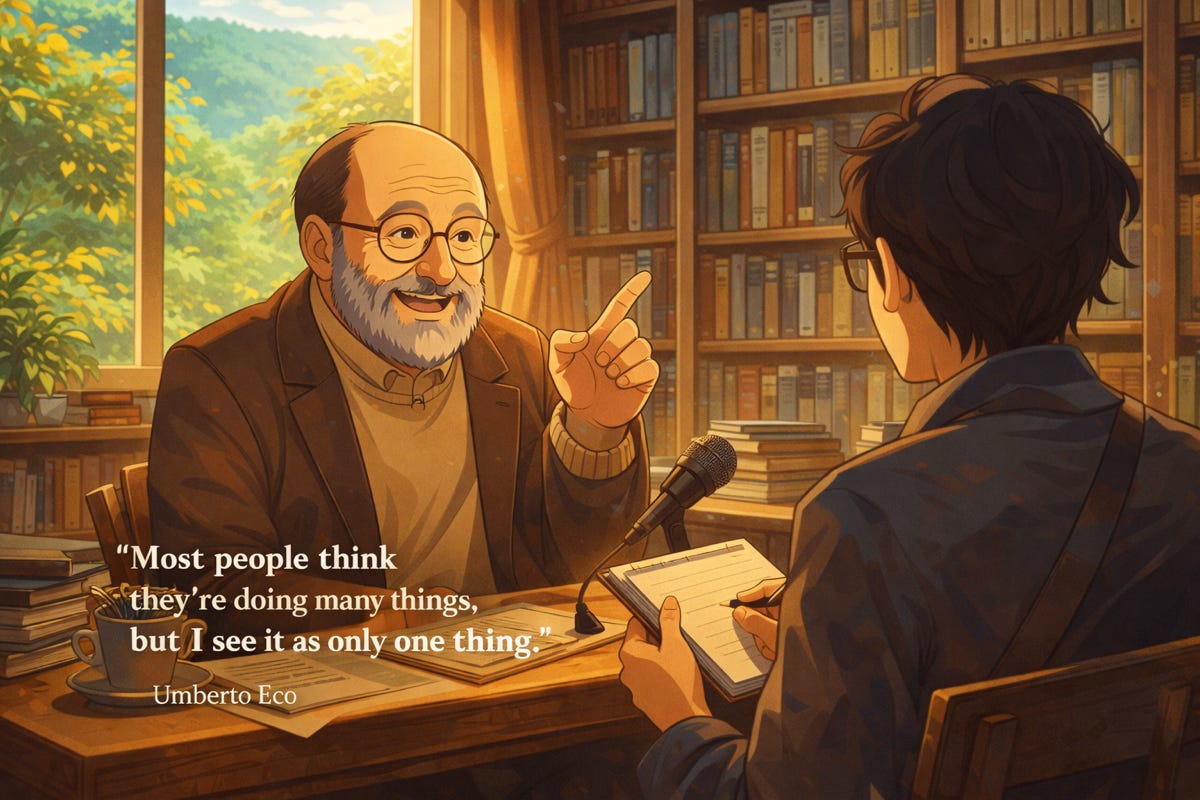
The question interested me then. It interests me more now, because it describes the condition most of us live in.
We build a day job over years of effort. It pays our bills, provides social standing, and creates stability. I am fully in favor of maintaining such a structure and taking it seriously, unless it begins to erode one’s mental peace. In the best case, one even comes to enjoy the work itself.
But whether one enjoys it or not, another question remains. What if one wants to express oneself creatively, purely out of inner disposition, without reference to money, status, or security?
This kind of expression at this point in my life feels like a necessity to fight the repetitiveness that the modern daily job brings out of its nature. This is the same need, I contend, that Umberto Eco must have felt, which put him on the novel-writing path, knowing fully well that he had a satisfactory, or rather a prestigious, job in hand.
So the question the interviewer asked Eco, which is relevant to us, is this:
For all of us who have a daily job to maintain but also want to express ourselves creatively, how can we do so continuously and sustainably?
This is the precise question that was answered for me in that interview seventeen years back. Even though I was a kid back then, I knew this mental model would come in handy in the future, and thus I have carried the answer with me ever since.
I have applied it repeatedly, often without consciously noticing it. The results are pretty solid:
For this blog that you are reading wouldn’t exist had I not applied that answer to my life.
Similarly, my engagement with meditation, philosophy, and spiritual inquiry has been sustained because of it.
I have learned and refined skills across very different domains using the same understanding, be it from storytelling to skiing, from sailing to squash, because of that answer.
So! What mental model am I talking about?
When the interviewer asked how he could reconcile the contradictory demands of his day job with what is necessary for writing serious fiction, Eco readily submitted his secret.
“And then I have a secret.”
“Did you know what will happen if you eliminate the empty spaces from the universe, eliminate the empty spaces in all the atoms? The universe will become as big as my fist. Similarly, we have a lot of empty spaces in our lives. I call them interstices.”
“Say you are coming over to my place. You are in an elevator, and while you are coming up, I am waiting for you. This is an interstice, an empty space. I work in empty spaces. While waiting for your elevator to come up from the first to the third floor, I have already written an article! (Laughs).”
He gave an example. Suppose you are coming to visit him. You are in an elevator, moving upward. He is waiting for you. That interval is an interstice.
Most people experience it as nothing. He did not. While the elevator moved from the first floor to the third, he said, he had already written an article!
What Using Empty Spaces Changed
I must have read that interview only once, but it has stayed with me for seventeen years.
The reason is clear to me now. The person speaking had already reached a state I still aspire to. He had written work that others wanted to read without reducing its intellectual, psychological, or philosophical depth. He had done so while maintaining the structure of his professional life. This is precisely the goal that currently motivates me, and Eco serves as a human ideal for me, someone I want to learn from.
Because of him, I do not see my day job as an obstacle as of today. I see it as form. It gives shape to the day. Without form, effort disperses.
Because of him, my life has quietly organized itself around this idea of empty spaces, of interstices.
An interstice is the walk from my apartment to the station in the morning. The door has closed behind me. The phone is still in my pocket. The day has not yet begun. One sentence forms there, usually incomplete but clear enough to return to later.
Another interstice is the platform while waiting for the train. Nothing can be done to hurry it. Most people fill that time immediately with doom scrolling. By this time, I have come across an interesting insight into what could be the main theme of my next blog post.
There is a third interstice between exiting the station and entering the office building. The mind is alert. The workday has not yet taken hold. A paragraph is revised there, without writing a word. By the time I sit down, the introduction and the article's theme are ready!
None of this feels deliberate while it is happening. It feels like waiting. It feels like moving through the day as usual. And yet, these insights accumulate. A piece of writing takes shape. A line of inquiry deepens. A skill stops feeling borrowed and begins to feel owned.
From the outside, it may look like discipline. From the inside, it feels like nothing extra was added. Only the empty spaces were used.
I notice them now. I return to them. I leave something small there. I make a note of it in my ever-expanding Google Doc of ideas and concepts that interest and intrigue me. And then I continue on.

Outside of writing, and more generally, the interstices present a philosophy and a technique for accommodating the seemingly contrasting demands that a modern man faces every day. And because of this, the next time someone says, I can’t find time to do something important, tell them the power of empty spaces, the power of interstices, and see how their face blooms with excitement, for they have found a fix for the ever-burdening disease of too-much-to-do-but-not-enough-time-whataboutry.
Two points
1) I disagree with first part of the article - the need for ideals. They are very important but at some point one has to figure out one's groove.
2) what Eco is describing to me felt like "dewangi". Not sure what's an English word for it. Dewangi hogi to the intellectual and creative aligns effortlessly. Eco's dewangi about writing made him find process which worked for him. Not the other way around. Dewangi dhoond kislay !!!
all the while, as I was reading this kept playing in my mind: https://www.instagram.com/reel/DSunmMdEcoF/?igsh=MTZhazZyeHR6eDgxYg==
Out beyond the ideas of ambition, there’s a field. I’ll meet you there ;)
hey but for mere mortals like me - this is a gem 🙌