

There are moments in life when an everyday frustration suddenly opens up into a much larger insight. A missed opportunity on a campus notice board. An endless cycle of refreshing a government website. At the time these moments feel small and irritating, but in hindsight they reveal something deeper about how the world works. For me, both of these experiences ended up pointing toward the same realization: technology, at its heart, is about distribution.
A Personal Story
Placement season in my undergrad at IIT BHU was a strange kind of ritual. It was my fourth year, and the whole campus carried a nervous energy that was hard to escape. Everyone knew, with the exception of those in computer science, that their careers were going to land in software regardless of what they had studied. Mechanical, civil, electrical—it did not matter. The funnel always ended in code. And the weight of this reality was heavy, because if you missed the placement season you were told you were staring into a future full of uncertainty.
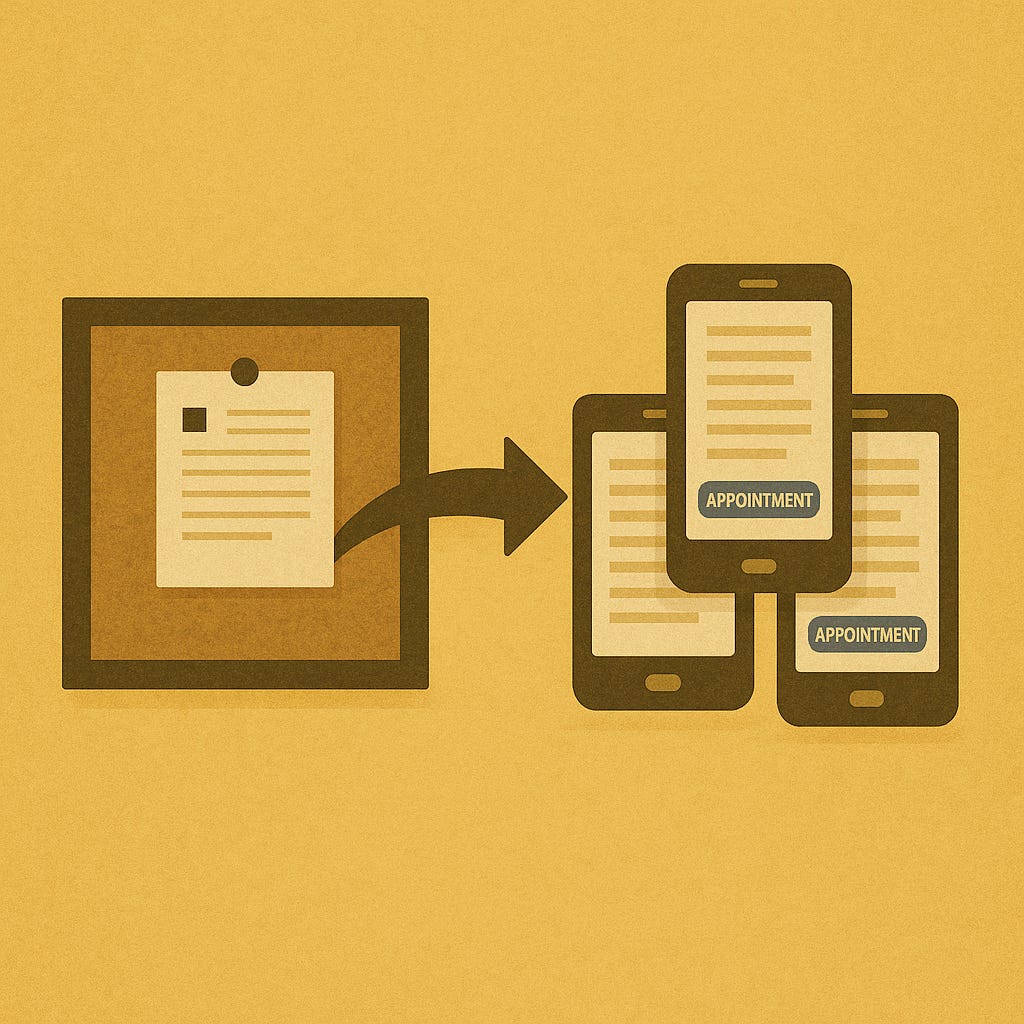
This was 2015 and at the time I had already half-convinced myself that I wanted to pursue research in the United States. That meant I was not fully consumed by the placement race, but I could still feel the tension radiating through the halls. What made the whole season unnecessarily difficult was the way information was handled. Our Training and Placement Office functioned like a slow and outdated bureaucracy. When a company came to campus, the announcement was a single sheet of paper pinned on the notice board inside their office. That was it. Whether you learned about it or not depended entirely on luck and timing. Many of us found out about opportunities only after they had passed, which meant you could miss the chance to even sit for the first round of tests.
It was frustrating, because the problem was not a lack of jobs or a lack of talent. It was that crucial information was stuck on a wall. Then one of my close friends built something that seemed simple at the time but felt extraordinary. He wrote a Python application, deployed it on AWS, and connected it with Pushbullet notifications. Placement coordinators could now feed announcements into the app directly, and every student with an Android phone received an instant alert whenever a new company arrived.
The effect was immediate. What once felt like a lottery suddenly felt manageable. The Training and Placement Office had not changed its nature, but the entire experience of students had changed because information began flowing freely.
That was the first time I truly understood the power of technology. It was not about inventing jobs or companies. It was about distributing information in a way that mattered.
A Modern Parallel
Today in 2025, which is exactly ten years since I graduated, I found myself in Jersey City, facing a remarkably similar problem. This time the setting was the DMV. I needed a road test slot, and the website showed nothing available for months. But if you kept refreshing, sometimes a cancellation would appear for a much closer date. The trouble was that unless you happened to refresh at exactly the right time, those slots were gone before you could click. It was a system that demanded endless refreshing, with missed opportunities being the norm.
The déjà vu was unmistakable. This was the same problem I had seen back at IIT BHU. So, I turned to the same type of solution. With the easy guidance of ChatGPT I wrote a Python script and set it up to run on GitHub Actions. Every five minutes the script checked for open slots and notified me instantly if one appeared. Suddenly, I did not need to sit there refreshing endlessly. The frustration dissolved into a steady flow of information.
It was such a small hack, but it reminded me of that earlier moment when I first realized what distribution can do. The difference between before and after was not more information but better distribution of it. The pain of missed chances disappeared once the flow became automatic.
The Distribution Lens
This is when a larger realization began to crystallize. What we often call “techification” is, at its heart, about solving distribution problems. The internet provides a kind of highway for information exchange between those who supply and those who demand. Without it, most solutions look like narrow sidewalks, small and unreliable. With it, we suddenly have scale, speed, and fairness.
We like to think of technology as sleek apps, smart algorithms, or eye-catching designs. But beneath all of that is something more fundamental. Technology works when it allows information, goods, or opportunities to flow without friction. It is not about the “coolness” of the tech itself. It is about the way distribution changes the lived reality of people on either side of the exchange.
Breakthroughs and Limits
Once you see technology through the lens of distribution, many examples fall into place. Amazon became what it is by solving the distribution of goods at scale. Uber connected idle cars with riders in a way that created entirely new patterns of movement in cities. YouTube and Instagram made it possible for a creator in a small town to find an audience across the world. Even dating apps are nothing more, and nothing less, than distribution systems that connect profiles into matches.
On the other hand, failures also look clearer in this light. WeWork, for example, helped make coworking spaces more discoverable. But it could not change the underlying supply constraint of real estate. Discovery was improved, yes, but distribution was still tethered to the hard limits of physical space.
A Historical Analogy
This pattern is not new. Human progress has always depended on distribution revolutions.
Sea-going vessels carrying goods across continents fueled the vast fortunes of the British Empire throughout the 17th and 18th centuries, turning trade routes into arteries of power and wealth.
Electrical wires carried energy into homes and factories, unlocking modern industry and reshaping the very rhythms of daily life.
The internet spreads information across the globe at lightning speed, unleashing modern technology and transforming how societies connect, learn, and create.
Each of these leaps solved the distribution problem, be it for physical goods, energy or information.
Streams of Distribution
Seen this way, the internet has opened up rivers of distribution in many directions. It has reshaped how content and attention flow, through platforms like YouTube, TikTok, and Substack. It has made trust and reputation portable through reviews, GitHub repositories, and LinkedIn profiles. It has reorganized relationships and communities through dating apps and Discord. It has redistributed capital and opportunity through Kickstarter campaigns and remote job platforms.
All of these are different expressions of the same underlying principle. Distribution is the quiet engine that runs beneath them.
Closing Reflection
I was listening to a cinema conference where actors and distributors were in conversation, and one remark stayed with me: “Content is King, but Distribution is God.” The speaker’s point was that no matter how good your content is, it won’t find the fame or money it deserves unless the right distribution channels carry it forward to the right audience. And those who control distribution platforms hold the real leverage — with the greatest potential to become wealthy, not by being unfair, but simply by being the indispensable bridge between creators and audiences.
And it is in this distribution-channel theme where the true breeding ground of innovation exists. Consider Netflix: it didn’t start by producing films, but by reimagining digital distribution, it redefined how the world consumes cinema. Or Spotify, which disrupted music not by creating songs but by transforming how they reached listeners. Similarly, Apple’s App Store and YouTube built massive ecosystems by becoming distribution hubs for apps and videos rather than by making all the content themselves.
This pattern holds beyond the media. Visa, for instance, doesn’t create money or issue credit — but by operating the rails through which payments flow, it became one of the most valuable companies in the world. Stripe followed a similar path in the digital age: it didn’t reinvent money, but by building developer-friendly APIs, it democratized access to payment infrastructure and became the invisible backbone of countless startups. And on a global scale, the Suez Canal shows the same principle in the physical world: it doesn’t manufacture a single good, yet by serving as a vital artery for global trade, it commands immense economic and geopolitical influence.
In every domain, distribution channels aren’t just middlemen rather they are often the deepest sources of leverage and the spark for transformative innovation.
Very good observations and well illustrated with examples. In figuring out what to do one may have to decide whether one want to be on content side or distribution side.