

I was trying to inflate my car tires because I had to hurry over to a friend's wedding. While doing that, I plugged in the pump and was checking the PSI of the other tires. I was also listening to a conversation between Bernardo Kastrup and Swami Sarvapriyananda. And as someone coming from a good eight to nine years of steeping myself in Advaitic literature, while living a balanced life, I couldn’t stop feeling sudden jolts of ecstatic joy now and then.
Clearly, the two philosophers were breaking - or should I say, showing the limits of language, which sometimes can imprison our minds, as language is how we think about things, form thoughts, and even suffer.
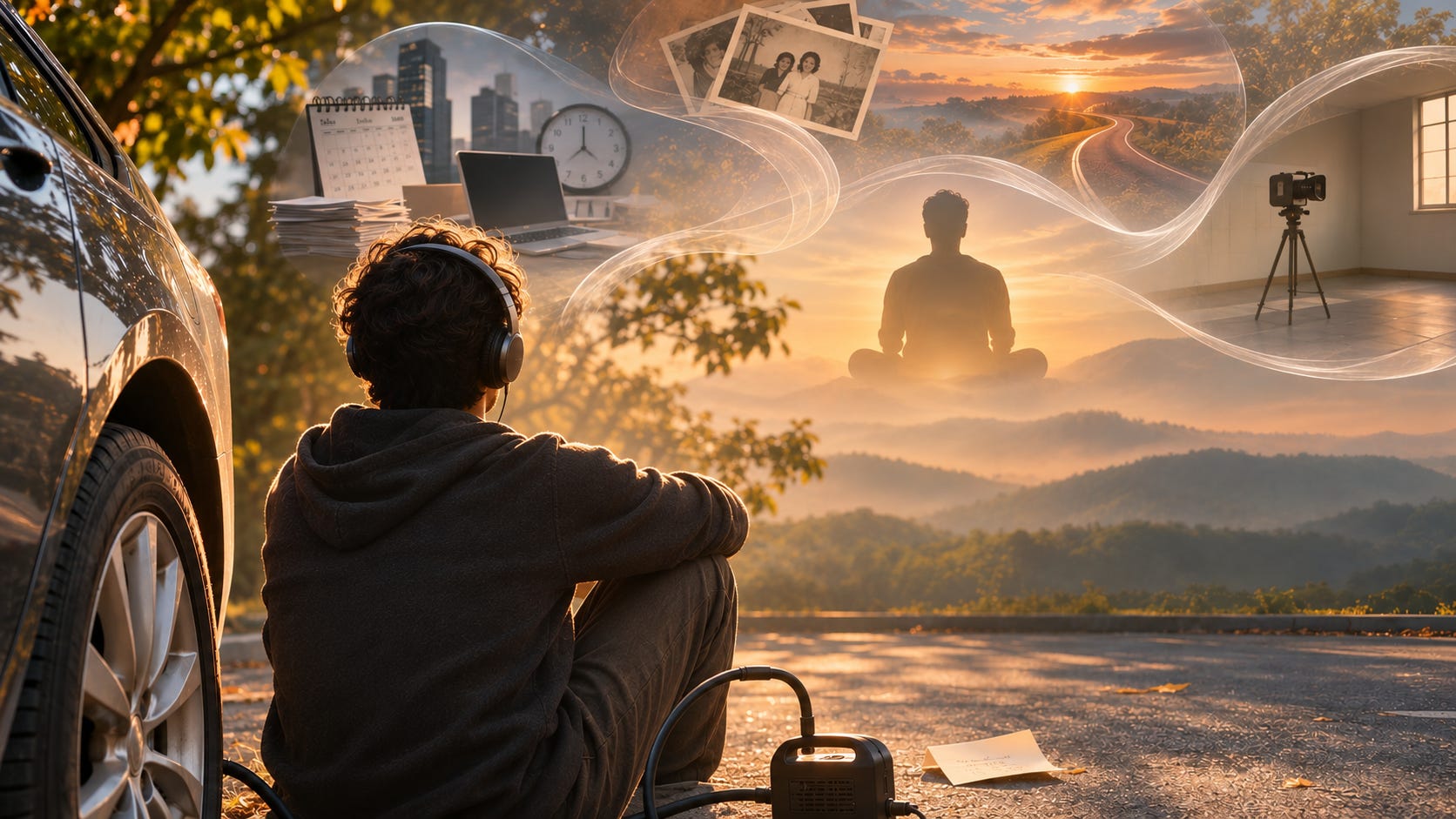
The camera example is one that I remember distinctly. Swami Sarvapriyananda was describing an argument someone had made to establish that the world exists independently of consciousness. The person proposed leaving a camera with its recording system switched on in a room without anyone present and examining the recording afterward. This, he believed, conclusively proved the fact that this external world exists apart from us, the subject experiencing it.
Swami responded by pointing out that the entire experiment that this guy proposed, from conceiving it, to bringing in the camera in an empty room, and then going to a different room, and then coming back and examining the recording, has to take place in this person’s awareness. At what point, he asked, would he have stepped outside of his awareness to even do this experiment from start to end?
Hearing this felt as if my whole life got unpacked. Somehow, since we get automatically conditioned by society into the third-person view, it jolted me and brought me to the first-person view immediately.
It helped me immediately flash upon this idea that all my life is essentially just first-person experiences. Even the intellectual theories like socialism, communism, democracy, other people, my own thoughts, the stress, and everything that I have encountered and have thought of as personal or other, all of them have come to me as experiences.
The point that struck me wasn’t so much about proving whether the room existed independently or not. It was this quick movement from one perspective to another, which I found extraordinarily powerful. Everything that had seemed to be part of an external world was now being examined from the standpoint of my actual experience of it.
Another example that I remember distinctly is when Bernardo said what really is the past and what really is the future, in terms of lived experience. He was talking about how the past is a memory experienced now, and the future is an expectation experienced now.
Ordinarily, we speak of the past and future as though they are simply there, independently of us, and we spend practically our entire lives worrying about one and planning for the other.
But what does the past actually amount to in our experience?
A memory experienced by me right now.
And the future?
An expectation experienced by me right now.
We who work in any corporate setup know that we live in the world of future planning in terms of quarters and sometimes have to work our asses off to meet weird deadlines. This stress that comes from the fact that we have to be productive and get things done within a short time is one of the reasons the modern world feels extremely stressed or burned out.
And suddenly, when you listen to Bernardo’s explanation, you realize, oh wait, it is “I” who experiences time! Yet all this while, I had been living as though time were the thing governing me!
Earlier, these thoughts of the past and future had felt like dumbbell weights that I had never agreed to lift. Yet, for whatever reason, someone had just handed them over to me without my consent, and daily life somehow expected me to keep carrying them.
This external pressure, which I felt was determining my destiny, was not really external in the way I had imagined. Rather, it was something I was experiencing, something to which I had been lending so much existence and importance in my everyday life.
It is like I built the cocoon and then I myself forgot this fact, and then finally, due to this forgetfulness, started feeling trapped in my own device myself!
How amazing is this reversal! To suddenly recognize that the weight I had been carrying was not quite what I imagined it to be!
The deadlines and responsibilities are still there, but the pressure I experienced in relation to them is not quite the “independent” thing I had made it out to be. It was I who, through my first-person experience, gave these pressures a touch of reality. Somewhere along the way, I had forgotten my “Real Nature” as limitless, bare Awareness, in which all these experiences appear. Repeatedly acknowledging this gradually loosens the thought residues that one might have accumulated through the daily rigor of corporate life. And this is the beauty of Advaita Vedanta.
It reformulates, or rather, just clarifies, the experience of life we are already having as subjective beings. And it does so with such extraordinary clarity that one can suddenly feel freed from things that had been burdening the mind for a long time.
And this distinction matters because I am not talking about making the world disappear. I am talking about how suddenly one can experience the same world from an entirely different standpoint.
It immediately reframed me to think of myself as this primal being who is basically just experiencing life now, and life from this standpoint is just a continuous series of experiencing “nowness”.
It stripped away all the descriptions of me for a moment. And I smiled automatically. I didn’t have to sit there and work out a philosophical argument before allowing myself to feel happy. I was simply standing beside my car, filling the tires, and something about the way I had been experiencing my own life had changed.
Well, after filling my four tires, I found a small note from someone saying that they had scratched my car. I had completely missed it, but I was still not sad. I also realized I had to figure out how to make the right insurance claim, and I did not feel particularly bad because I know that I have a car and this is bound to happen sooner or later. The fact that something inconvenient had happened did not automatically have to become an occasion for suffering.
And here I would rather attribute such happiness to the Vedantic samskaras. My study of Advaita has refined my mind, and I now deliberately, almost artificially, push these mahavakyas into my mind as an everyday ritual. Think of it as an everyday satsang. I have spent nine years steeping myself in these teachings, and I would rather attribute the happiness emanating from me to those Vedantic samskaras than to a single conversation that I happened to hear this afternoon.
The conversation immediately brought these ideas into focus, but the mind had already spent years becoming acquainted with them. Perhaps that is why such a simple articulation of ordinary experience could produce such a sudden movement in me.
Again, I don’t want to get too intellectual here, but rather just explain and describe the lived reality. That’s why I like fiction more than nonfiction these days, because in our attempt to non-fictionize everything, we are killing the qualia part of life.
This is what these examples from the two stalwarts immediately jolted me into: the lived experience itself, rather than merely an intellectual description of it.
And staying with that experience a little longer is actually more useful than immediately trying to explain it away. Sometimes we become so interested in explaining what happened that we immediately move away from the experience that made us happy in the first place.
Advaita’s timeless beauty is in its ability to provide an extraordinary clarification of ordinary experience. It does not ask you to believe in something outside of what you already know, nor does it demand that you master a complex armchair philosophy which is far removed from lived daily life.
What a beautiful open-secret-like gateway to pure joy!
What is the extraordinary clarification of ordinary experience ? It is precisely as you said that the ordinary experience is a continuation experience of “nowness”. In order words there is nothing ordinary in any experience, there is only the extraordinary in all experiencing 😊
I like that sentence a lot. Good one bro 🙌